

ՀԱՅ ԱՒԵՏԱՐԱՆԱԿԱՆ ԵԿԵՂԵՑԻՆԵՐՈՒ ՄԻԱՑԵԱԼ ՈԳԵԿՈՉՄԱՆ ՀԱՆԴԻՍՈՒԹԻՒՆ


ՀԱՅ ԳՐԱՏՊԱԳՐՈՒԹԵԱՆ 500 ԱՄԵԱԿԻ ՆՈՒԻՐՈՒԱԾ ՀԱՅԿԱԿԱՆ ՄՇԱԿՈՅԹԻ ԵՒ ԳԻՐՔԻ «ՑՈՒՑԱՀԱՆԴԷՍ-ՎԱՃԱՌՔ»


The Word that cannot be hidden
“Jesus answered, ‘I tell you that if they keep quiet, the stones themselves will start shouting’” Luke 19:40
As Jesus was entering Jerusalem people spread their clothes on the road so that the King of Glory could pass. It was a moment of great joy. Everyone was shouting and singing, “God bless the king who comes in the name of the Lord! Peace in heaven and glory to God!” (Luke 19:38).
The Pharisees, though, were disturbed by this. But why?
One could say maybe because they were jealous. People were turning to Christ because of the miracles and healings he was performing. Jesus despised praise from the proud. He accepted praise from the humble. Also, the Pharisees were angry at him because they could see how He had attracted the people to him and they couldn’t silence Him, for it is written, “If they keep quiet, the stones themselves will start shouting” Luke 19:40.
This verse unleashes extreme power!
Vahé Jébéjian
As Jesus was entering Jerusalem people spread their clothes on the road so that the King of Glory could pass. It was a moment of great joy. Everyone was shouting and singing, “God bless the king who comes in the name of the Lord! Peace in heaven and glory to God!” (Luke 19:38).
The Pharisees, though, were disturbed by this. But why?
One could say maybe because they were jealous. People were turning to Christ because of the miracles and healings he was performing. Jesus despised praise from the proud. He accepted praise from the humble. Also, the Pharisees were angry at him because they could see how He had attracted the people to him and they couldn’t silence Him, for it is written, “If they keep quiet, the stones themselves will start shouting” Luke 19:40.
This verse unleashes extreme power!
- It states that the world and all its components, even non-living things like stones which don’t have a soul, are amazed and overwhelmed by God’s glory! God’s glory doesn’t just affect humankind. It has cosmic radiance, a universal impact. His glory is felt by the entire world and all its beings. It’s a message that even rocks cannot hide it anymore. It needs to be proclaimed from mountain tops to the ends of the seas. In this verse we see a deep and profound correlation between Christ’s message, the Word and the Universe.
- There is no way to keep quiet. The word “quiet” is very quickly replaced by the word “shouting”. God’s message provides so much joy and happiness that keeping quiet is not an option. Even more than that, it is impossible! The Word can’t have boundaries. It doesn’t have any limits. It isn’t confined in a cage! It’s a free Word, free from chains humanity has set and free from social and cultural chains. God’s message of love, hope and salvation is a message that surpasses all human understanding and that cannot be drowned by any power in the Universe.
- Even stones can’t keep the Word from being proclaimed! How about us, living creatures? In this 21st century, it so happens that the responsibility of spreading the Word has been entrusted to us. It is our duty, with Christ’s help, to spread the Word as far and as wide as possible. Don’t keep quiet. Shout the name of the Lord! Remember, if Christ can raise up children of Abraham out of rocks just imagine what He can do for you and for others.
Vahé Jébéjian
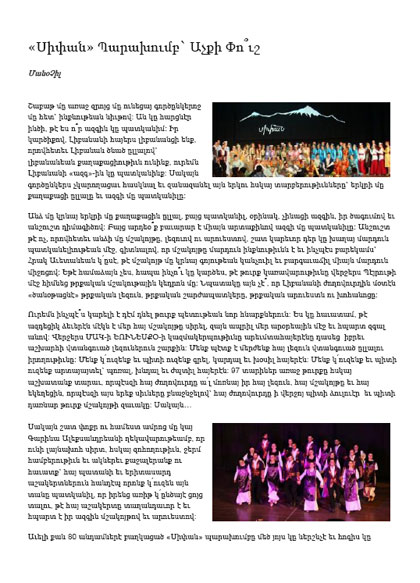
«Սիփան» Պարախումբ` Աչքի Փո՞ւշ
Շուշիի Ազատագրման 20-րդ Ամեակը


Իմաստուն Կինը Իր Տունը Կը Շինէ - Տիկ. Րուզան Սալխանեան
Renovation Work in Kchag, An Interview with Mr. Garbis Deyirmenjian

It was several years ago that KCHAG (the Christian Endevour Summer Campsite) was returned to its rightful owner, the Armenian Evangelical Church, in the conditions that you see in the above photoshoot, with doors and windows shut, church building worn out, the cross removed and the site used by local and foreign militaries.
Unders these dire circumstances, the Kchag Construction and Development Committee, decided to revive the campsite to become a lighthouse again for the young men and women to find Christ again.
In order to find out more about the renovation work, we had an interview with Mr. Garbis Deyirmenjian, one of the members of the Kchag Construction and Development Committee.
(Interview conducted by Raffi)
Unders these dire circumstances, the Kchag Construction and Development Committee, decided to revive the campsite to become a lighthouse again for the young men and women to find Christ again.
In order to find out more about the renovation work, we had an interview with Mr. Garbis Deyirmenjian, one of the members of the Kchag Construction and Development Committee.
(Interview conducted by Raffi)
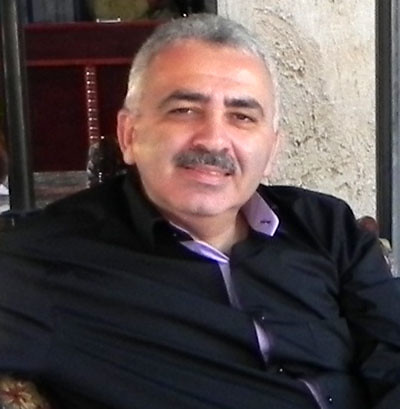 Raffi - In our last interview with you in 2010, you mentioned that Bezjian was being renovated. Now that this is thankfully achieved, what are the parts that the Kchag Committee is aiming to restore and renovate?
Garbis - For the time being the Church is being renovated and it is expected to have the opening in the beginning of this summer. We are using the church since 2002 without a major renovation, and it was really in a bad position when we got Kchag back. As announced last summer, our brothers in Netherlands took the initiative to share with us the major cost. The most important issue for us is to worship God again in this chapel and to let people know Christ in Kchag as it was for many years for a lot of people.
The next step is the main construction project, which was announced in July 2011 during the dedication of the "Kassarjian" building. We are in the process of getting the construction permit, and getting it in a short time and without complications can be called an "achievement" in Lebanon.
The next step is the main construction project, which was announced in July 2011 during the dedication of the "Kassarjian" building. We are in the process of getting the construction permit, and getting it in a short time and without complications can be called an "achievement" in Lebanon.
Raffi - You had also mentioned that you'll be endeavoring a fundraising plan to find donors. Can you tell us about this experience both locally and globally?
Garbis - The fundraising is in process. We are very happy that there are people who have a great heart for Kchag, for the youth and for Lebanon. So far we have around 8 donors, who have donated for certain projects in KCHAG, which will be executed after getting the main construction permit. The donors are from different parts of the world; USA, Europe, Australia and Lebanon.
Raffi - What kind of problems have you faced and are there any problems that you are facing today?
Garbis - We always have problems and try to solve them with God's help and through our efforts. They are legal issues for getting permit for construction, problems related to the legal situation of the existing buildings, the shortage of water in the area and having a good janitor. Also to have more donors and funds in order to complete the major part of the project through planned phases.
Raffi - What are the plans for Kchag Café this year?
Garbis - Kchag Café could be planned in a different way this year, it is Kchag Khenamagal's project. It could be different since the church is being renovated this year and it will not be good to do the Kchag Café in-front of the church anymore. We can plan for it in a different way and with a different concept.
Raffi - What is next for Kchag and the upcoming challenges?
Garbis - To start the main construction, by building 4 new dorms and the dining hall. To plant new pine trees since some of them will be removed during the construction and some of them are already damaged because of natural issues.
Raffi - In the end, what would you like to say to our readers?
Garbis - Thank you for your prayers and support. We ask you to continue your support and let's find more donors to continue the construction. Still we need many people to donate dorms, for other facilities and public areas.
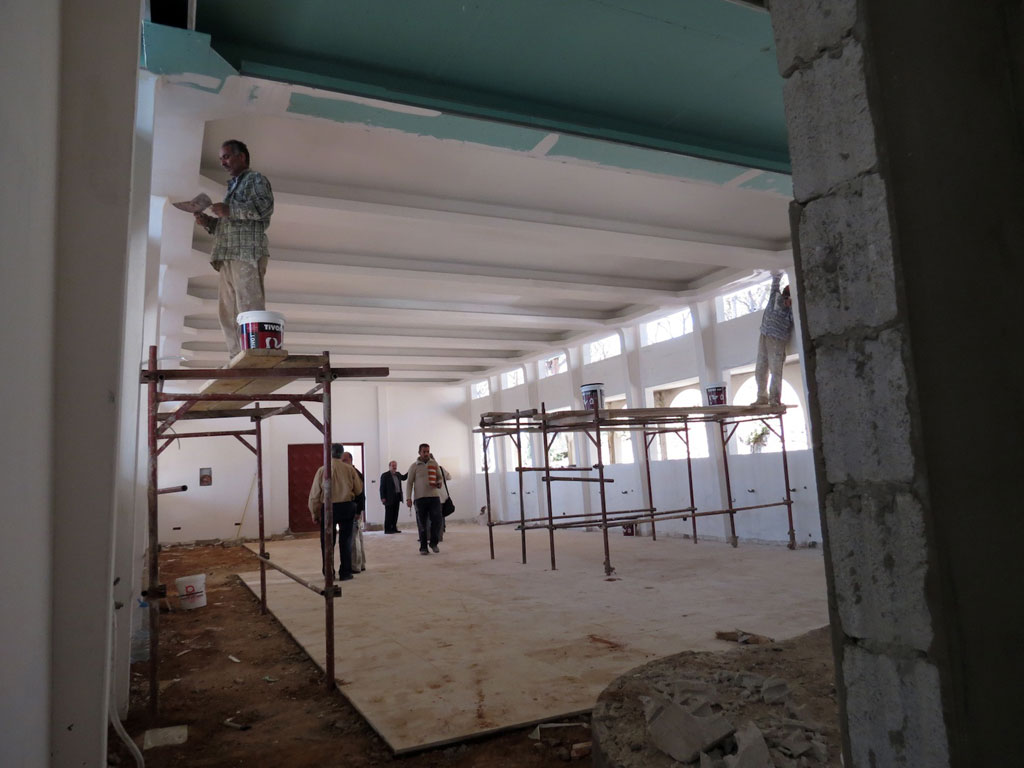
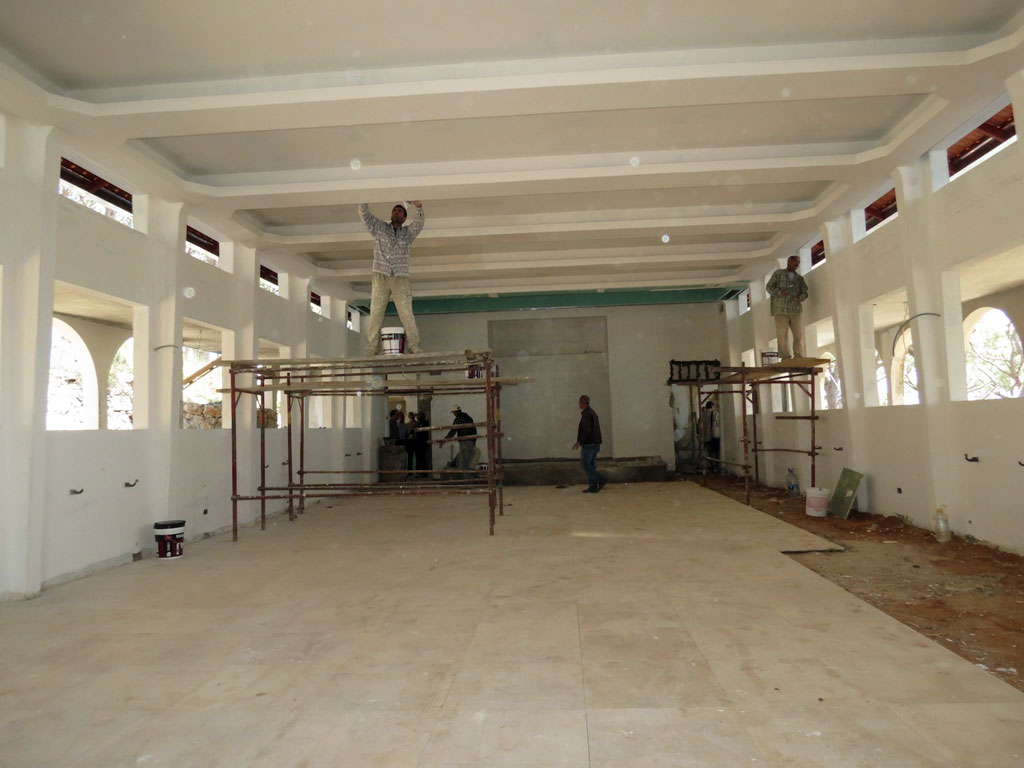

Photos provided by Garbis Deyirmenjian
Haigazian University celebrates the 100th Anniversary of Armenian Press in Lebanon
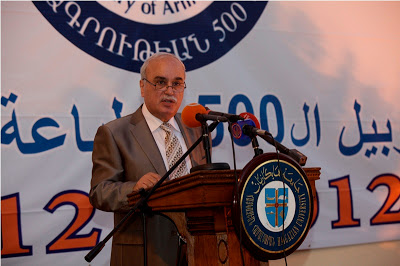
On Monday, May 7, 2012, Haigazian University hosted its second event under the umbrella of the500th Anniversary of Armenian Printing and the 100th Anniversary of Armenian Press in Lebanon.
Launched under the patronage of Minister of Information, H.E. Me. Walid Daouk, and in the presence of Minister of Industry, Mr. Vrej Sabounjian, MPs Hagop Pakradouni and Serge Toursarkissian, former MPs and government officials, an outstanding and unique exhibition traced the century-long history of Armenian print media in Lebanon, dating back to 1912. The event opened with the welcoming words of Dr. Arda Ekmekji, Dean of the Faculty of Arts and Science, in the name of the organizing committee. Ekmekji offered a brief historical background of Armenia’s 500-year history with printing and publication, and she discussed how the Armenian written press had played an important role in the advancement of the Armenian community in Lebanon.
Dr. Armen Urneshlian, a representative of the organizing committee, tackled the scientific approach of the Armenian specialized press, covering such issues as research methodology for scientific and academic journals and other publications.
University President Rev. Dr. Paul Haidostian, expressed his gratitude to the minister for his patronage, before allowing him to take the floor.
Minister Daouk addressed the important role of Haigazian University and of the Armenian community by blending in with the larger Lebanese society while simultaneously preserving their identity and culture. Daouk gave examples of Armenian pioneers in the field of media in Lebanon, including a former Minister of Information, the late Me. Khatchig Babikian, and the first photojournalist in Lebanon George Semerdjian.
This was followed by the ribbon cutting ceremony and the official opening of the exhibition, which features the first issues of around 150 historical posters and print media pages that tell the story of 100 years of Armenian press in Lebanon. The exhibition is open until Saturday, May 12, from 3 to 7pm.


Launched under the patronage of Minister of Information, H.E. Me. Walid Daouk, and in the presence of Minister of Industry, Mr. Vrej Sabounjian, MPs Hagop Pakradouni and Serge Toursarkissian, former MPs and government officials, an outstanding and unique exhibition traced the century-long history of Armenian print media in Lebanon, dating back to 1912. The event opened with the welcoming words of Dr. Arda Ekmekji, Dean of the Faculty of Arts and Science, in the name of the organizing committee. Ekmekji offered a brief historical background of Armenia’s 500-year history with printing and publication, and she discussed how the Armenian written press had played an important role in the advancement of the Armenian community in Lebanon.
Dr. Armen Urneshlian, a representative of the organizing committee, tackled the scientific approach of the Armenian specialized press, covering such issues as research methodology for scientific and academic journals and other publications.
University President Rev. Dr. Paul Haidostian, expressed his gratitude to the minister for his patronage, before allowing him to take the floor.
Minister Daouk addressed the important role of Haigazian University and of the Armenian community by blending in with the larger Lebanese society while simultaneously preserving their identity and culture. Daouk gave examples of Armenian pioneers in the field of media in Lebanon, including a former Minister of Information, the late Me. Khatchig Babikian, and the first photojournalist in Lebanon George Semerdjian.
This was followed by the ribbon cutting ceremony and the official opening of the exhibition, which features the first issues of around 150 historical posters and print media pages that tell the story of 100 years of Armenian press in Lebanon. The exhibition is open until Saturday, May 12, from 3 to 7pm.
500th Anniversary of Armenian Printing (1512 – 2012)
On Saturday, May 5, 2012, Haigazian University launched the first of a series of fine events dedicated to the 500th Anniversary of Armenian Printing (1512 – 2012), which coincides with the 100th Anniversary of Armenian Press in Lebanon (1912 – 2012).
This kick-off event started with a delegation from the university, headed by University President Rev. Dr. Paul Haidostian and media editors, at Martyr’s Square in Downtown, Beirut, coinciding with the commemoration of May 6, the Lebanese Press Martyrs’ Day. The delegation adorned the monument to the martyrs with a wreath of flowers and Rev.MegrdichKaragoezian,president of the Union of the Armenian Evangelical Churches in the Near East, offered a prayer.
The event then continued at Haigazian University, where various media personnel, including editors, columnists, copy-editors, photographers and others, were invited from 25 different published media outlets to honor the workforce of the Armenian print media in Lebanon, including newspapers, magazines and journals.
The program started with the welcoming word of University Librarian, Ms. Sonia Sislian, in the name of the 500th Anniversary Committee. She announced the series of events that will take place throughout the year in commemoration of the 100th anniversary of Armenian press in Lebanon, and thanked all the Armenian media outlets for consistently providing the library with their issues, thus enriching the university’s collection of resources for manydecades.
This was followed by the guest speaker, renowned journalist Dr. BarouyrAghbashian, who tackled the importance of Armenian media in the Armenian community here in Lebanon, focusing on the media’s role in preserving the Armenian identity and its raison d’être. In his speech, President Haidostian noted that the success of the Armenian community has depended on the establishment of its well-organized institutions, in the cultural, social, educational, political and religious spheres, as well as, certainly, the media.
The event also included the performance of a string trio, featuring 2 pieces by the famous Armenian composer Komidas. Towards the end of the program,the media personnel were honored with tokens of gratitude. Each Editor-in-Chief received a plaque on behalf of theirinstitution as well as letters of appreciation for their designated staff members.
It is worth noting that Mr. GaroAprahamian, faithful member of the Haigazian University Derian Library Friends, received a special token of appreciation for his wholehearted services in providing issues of magazines and newspapers to the library for decades, thus playing a significant role in enriching its collection.
Public Relations Department
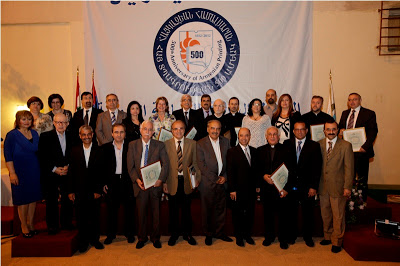
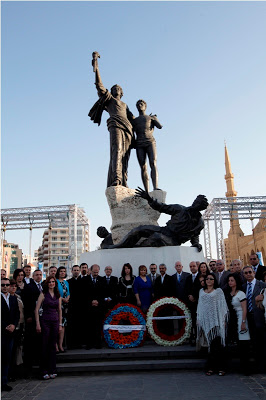
This kick-off event started with a delegation from the university, headed by University President Rev. Dr. Paul Haidostian and media editors, at Martyr’s Square in Downtown, Beirut, coinciding with the commemoration of May 6, the Lebanese Press Martyrs’ Day. The delegation adorned the monument to the martyrs with a wreath of flowers and Rev.MegrdichKaragoezian,president of the Union of the Armenian Evangelical Churches in the Near East, offered a prayer.
The event then continued at Haigazian University, where various media personnel, including editors, columnists, copy-editors, photographers and others, were invited from 25 different published media outlets to honor the workforce of the Armenian print media in Lebanon, including newspapers, magazines and journals.
The program started with the welcoming word of University Librarian, Ms. Sonia Sislian, in the name of the 500th Anniversary Committee. She announced the series of events that will take place throughout the year in commemoration of the 100th anniversary of Armenian press in Lebanon, and thanked all the Armenian media outlets for consistently providing the library with their issues, thus enriching the university’s collection of resources for manydecades.
This was followed by the guest speaker, renowned journalist Dr. BarouyrAghbashian, who tackled the importance of Armenian media in the Armenian community here in Lebanon, focusing on the media’s role in preserving the Armenian identity and its raison d’être. In his speech, President Haidostian noted that the success of the Armenian community has depended on the establishment of its well-organized institutions, in the cultural, social, educational, political and religious spheres, as well as, certainly, the media.
The event also included the performance of a string trio, featuring 2 pieces by the famous Armenian composer Komidas. Towards the end of the program,the media personnel were honored with tokens of gratitude. Each Editor-in-Chief received a plaque on behalf of theirinstitution as well as letters of appreciation for their designated staff members.
It is worth noting that Mr. GaroAprahamian, faithful member of the Haigazian University Derian Library Friends, received a special token of appreciation for his wholehearted services in providing issues of magazines and newspapers to the library for decades, thus playing a significant role in enriching its collection.
Public Relations Department