
WHEN RELIGIONS CLASH…
Lebanon, with its strictly sectarian system, is a unique nest of interreligious coexistence. Three monotheistic religions and about eighteen official sects are integrated in the Lebanese people’s daily lives. The religious pluralism gives rise to political instability within Lebanon’s civil and public spheres. Putting aside the once-in-a-while political ups and downs, the Lebanese have learned to tolerate the “other”, share their land, breathe the same air, live under the same sun, and declare everlasting brotherhood. This partnership reached a new horizon when interreligious marriages were not so uncommon anymore, and religious conversions were not that much of a “big deal”. Lebanon being the window to the Middle East is an ideological bridge, linking the East to the West, would be one of the first countries to be influenced by the notion of globalization, where the world would become, in Marshall McLuhan’s words, a ‘global village’, where geographic, political, economic, cultural and religious boundaries are no more respected, actually no more exist. Such is the case in Lebanon and the issue of interreligious marriages. Would the Lebanese also find a way to ‘solve’ this issue? Or would the “Christian Mohammads” and “Muslim Georges” carry Lebanese nationalities without having a real sense of identity to a single faith? For many couples religion unifies and strengthens their marriage, but for others it tears them apart. The latter is much more predictable.
 Views regarding interreligious marriages are very much diverse, yet overlapping. Human rights activists vigorously fight that love is a sacred right. They back up their argument with the UN Universal Declaration of Human Rights’ 16th article, where it states that: “Men and women of full age, without any limitation due to race, nationality or religion, have the right to marry and to found a family”. However, how realistic and future-oriented is this view? Do humans also have the right to be selfish? To live the present and forgo the future? To live romance and gamble faith? And to choose love over religion? When individuals from two different religions marry, they sometimes begin a lifetime of disagreements that can be devastating to the sacred union of marriage and parenthood. When disagreements arise, they are often over different views on core values, such as faith, prayer, repentance, forgiveness, respect, love, and compassion. These differences can stir up difficult conflict over religious upbringing of children, over decisions about how to handle life events such as birth, death, and holiday celebrations, and over the absence of a religious bond in the relationship.
Those who follow the philosophy of Kahlil Gibran are very much open to interreligious marriages. Gibran had a unique view of religious diversities as such: “I love you when you bow in your mosque, kneel in your temple, pray in your church; for you and I are sons of one religion, and it is the spirit” (The Voice of the Poet). However religious texts clearly state that religions are very much different and many of their verses forbid interreligious marriages. In general, Muslim men are not permitted to marry non-Muslim women. “Do not marry unbelieving women until they believe” (Qur’an 2:221). An exception is made for Muslim men to marry Jewish and Christian women, who are referred to as “People of the Book”. The children of such a union are always to be raised in the faith of Islam. Yet Gibran states: “You may give them your love but not your thoughts, for they have their own thoughts” (On Children, The Prophet). The Quranic verse continues: “Nor marry your girls to unbelievers until they believe”. No exception is given for women to marry Jews and Christians, so the law states that she may only marry a believing (Muslim) man. A Muslim woman does not follow the leadership of someone who does not share her faith and values. According to the Torah, Jews should not intermarry because their children will turn to other religions. “You shall not intermarry with them (other nations), do not give your daughters to their sons or take their daughters for your sons. For you will turn your children away from Me to worship other gods…” (Deuteronomy 7:1-3). Even St. Paul is exhibiting total intolerance of non-Christian faith groups; “Do not be yoked together with unbelievers. For what do righteousness and wickedness have in common? Or what fellowship can light have with darkness? What harmony is there between Christ and Belial? Or what does a believer have in common with an unbeliever? (2 Corinthians 6:14-15). Some may argue that these religious texts as old-fashioned, but that may even give rise to questioning God Himself.
 Political activists validate their tolerance of interreligious marriages with the argument that if multiple religions are tolerated within a country, multiple religions within a family should be allowed too. However, take the concept of Ashura. Shockingly, asking Muslims about the religious event would not just result in different but also contrasting answers. The two viewpoints belong to the Shiite and Sunni sects that although sub branches of a single religion, hold diverse perspectives of the same religious event. There are differences and misunderstandings within one religion and between sects; then what if it were in between two different religions? So now try to imagine a child having a Shiite father and a Sunni mother. How would both approach to teach their child religious obligations, such as Ashura? Whose perspective is the priority? Having in mind that we are still a patriarchal community to a certain extent, the father’s sect would have primary loyalty than the mother’s. So would the mother’s sect and beliefs be completely ignored? And what happened to women’s rights and equality? Although the Jewish community in Lebanon is small and ‘hidden’, but let’s take the surprising combination of a Jewish and Shiite couple. Who would the child tend towards? The Shiite community, where they shed tons of blood and martyrs to free the country’s Southern region and achieve Lebanon’s geographic integrity? Or towards the Jewish state, where they lead an immoral war against innocent people to regain the integrity of the ‘promised land’? Furthermore Orthodox Judaism considers a person born of a Jewish mother to be Jewish, yet in Islam, the child must be raised in the faith of Islam. So who “wins”?
Romantics believe that “love is blind”. They stress that one cannot just choose his/her life partner; instead, destiny has already chosen his/her soul mate for him/her. You can see couples bragging about their ‘love at first sight’, that butterfly feeling in their stomach, the increase of adrenaline in their veins, the sudden heart pumps, and cupids flying above them. Tolerating interreligious marriages, they stress that no one can forbid the other from loving and being loved, for “What God has united, man must not divide” (Matthew 19:6). While interfaith relationships develop based on a mutual respect for religious diversity, sometimes major differences in fundamental beliefs pose difficulties in finding a common ground. Religious differences could bring complexities in their married life, starting with religious conversions. Religious conversion may be a matter of just a brief ceremony, but do not underestimate this ritual as a trivial matter. Taking this oath will set a tone for your life and your children’s lives. You will soon find out that the conversion was not just a matter of satisfying the sentimental obsession of the parents-in-law, but a binding commitment guarded by every member of the new community. As associating partners with Allah is the greatest of all sins. Offering prayers or supplications to anyone, living or dead, is an unpardonable sin. Therefore, one should be prepared to acceptconversion to a new religion as a serious and irreversible process.
 Other activists argue that, in the truest sense, marriage is a secular act and not a religious one. Unfortunately, some religious leaders and communities would like to use the wedding as a tool for their ambition of religious expansion. This is not true. It is not a case of religious expansionism rather than preservation of generations, heritage, culture, values, traditions, and sovereign identities. Those who do not view marriage in its religious aspect are not looking at marriage in its future sense. In an inter-faith couple there is often no room to compromise without one spouse giving up some of their beliefs. Religious conversion is not a hollow ritual devoid of any meaning or consequences. Let’s take a Christian-Muslim marriage as an example. As per the Shahada oath to convert to Islam, one accepts and declares that there is no God but Allah and Muhammad is his messenger. Further, you acknowledge that associating others (like Jesus) with Allah is the greatest of all sins. Similarly, baptism before a church wedding means conversion to Christianity and a commitment to repudiate former practices (of Islam) and to live with Christ forever. Young children get confused with mixed and often conflicted messages. When confronted with such duplicity, children lose faith in any God or religion. Children with unclear religious orientations tend to be more nonreligious to avoid such complexities. This would cause a much more serious problem of atheism. Plus, to understand the relationship between the two religions a question pops up: “Is Jesus’ father, Mohammad’s God?” That is another story.
Do you see how complex these situations are? These were simple examples with no exaggerations whatsoever. There are many more simple things that make a big difference in interreligious marriages. The family kitchen and cuisine could be one of those simple complexities, where one’s national dish may be a ‘Haram’ to the other’s culture, or the wardrobe of one would be an insult to the other’s religion. When Jesus and his disciples were invited to a wedding in Cana (Lebanon) and when the wine ran out Jesus turned water into wine by performing a miracle. Wine is also used in religious ceremonies in almost all churches. However in Islam alcohol is strictly forbidden. Eating pork meat is another sin for Muslims, yet several cultures include pork meat in their dishes, the Armenian cuisine being one of them. And the complexities continue. Further, divorce rates in interfaith marriages are double compared to within the same faith marriages. A survey done by religioustolerance.org in March 2002 show that 50% of interfaith couples don’t last, separate and divorce; 25% of couples endure marriages which are almost totally lacking in intimacy; they co-exist in two solitudes, and the remaining 25% live in happy, mutually supportive marriages.

The Holy Bible states: “Love is patient, love is kind… It is not self-seeking”. (Corinthians 13:4-5). Be patient. Choose your life partners with care. Love both with heart and mind. Do not be self seeking, but rather think of who would come after you. Think about the infants you give life to, about their future, their psychological stability, their self-esteem and confidence, their identity and their relationship with God Almighty. You may be wise and faithful to your primary cultural group or you may go ahead and sing Elvis’ “I Can’t Help Falling in Love With You”. You’d better choose the first!
Hrag T. Avedanian

Views regarding interreligious marriages are very much diverse, yet overlapping. Human rights activists vigorously fight that love is a sacred right. They back up their argument with the UN Universal Declaration of Human Rights’ 16th article, where it states that: “Men and women of full age, without any limitation due to race, nationality or religion, have the right to marry and to found a family”. However, how realistic and future-oriented is this view? Do humans also have the right to be selfish? To live the present and forgo the future? To live romance and gamble faith? And to choose love over religion? When individuals from two different religions marry, they sometimes begin a lifetime of disagreements that can be devastating to the sacred union of marriage and parenthood. When disagreements arise, they are often over different views on core values, such as faith, prayer, repentance, forgiveness, respect, love, and compassion. These differences can stir up difficult conflict over religious upbringing of children, over decisions about how to handle life events such as birth, death, and holiday celebrations, and over the absence of a religious bond in the relationship.
Those who follow the philosophy of Kahlil Gibran are very much open to interreligious marriages. Gibran had a unique view of religious diversities as such: “I love you when you bow in your mosque, kneel in your temple, pray in your church; for you and I are sons of one religion, and it is the spirit” (The Voice of the Poet). However religious texts clearly state that religions are very much different and many of their verses forbid interreligious marriages. In general, Muslim men are not permitted to marry non-Muslim women. “Do not marry unbelieving women until they believe” (Qur’an 2:221). An exception is made for Muslim men to marry Jewish and Christian women, who are referred to as “People of the Book”. The children of such a union are always to be raised in the faith of Islam. Yet Gibran states: “You may give them your love but not your thoughts, for they have their own thoughts” (On Children, The Prophet). The Quranic verse continues: “Nor marry your girls to unbelievers until they believe”. No exception is given for women to marry Jews and Christians, so the law states that she may only marry a believing (Muslim) man. A Muslim woman does not follow the leadership of someone who does not share her faith and values. According to the Torah, Jews should not intermarry because their children will turn to other religions. “You shall not intermarry with them (other nations), do not give your daughters to their sons or take their daughters for your sons. For you will turn your children away from Me to worship other gods…” (Deuteronomy 7:1-3). Even St. Paul is exhibiting total intolerance of non-Christian faith groups; “Do not be yoked together with unbelievers. For what do righteousness and wickedness have in common? Or what fellowship can light have with darkness? What harmony is there between Christ and Belial? Or what does a believer have in common with an unbeliever? (2 Corinthians 6:14-15). Some may argue that these religious texts as old-fashioned, but that may even give rise to questioning God Himself.
Political activists validate their tolerance of interreligious marriages with the argument that if multiple religions are tolerated within a country, multiple religions within a family should be allowed too. However, take the concept of Ashura. Shockingly, asking Muslims about the religious event would not just result in different but also contrasting answers. The two viewpoints belong to the Shiite and Sunni sects that although sub branches of a single religion, hold diverse perspectives of the same religious event. There are differences and misunderstandings within one religion and between sects; then what if it were in between two different religions? So now try to imagine a child having a Shiite father and a Sunni mother. How would both approach to teach their child religious obligations, such as Ashura? Whose perspective is the priority? Having in mind that we are still a patriarchal community to a certain extent, the father’s sect would have primary loyalty than the mother’s. So would the mother’s sect and beliefs be completely ignored? And what happened to women’s rights and equality? Although the Jewish community in Lebanon is small and ‘hidden’, but let’s take the surprising combination of a Jewish and Shiite couple. Who would the child tend towards? The Shiite community, where they shed tons of blood and martyrs to free the country’s Southern region and achieve Lebanon’s geographic integrity? Or towards the Jewish state, where they lead an immoral war against innocent people to regain the integrity of the ‘promised land’? Furthermore Orthodox Judaism considers a person born of a Jewish mother to be Jewish, yet in Islam, the child must be raised in the faith of Islam. So who “wins”?
Romantics believe that “love is blind”. They stress that one cannot just choose his/her life partner; instead, destiny has already chosen his/her soul mate for him/her. You can see couples bragging about their ‘love at first sight’, that butterfly feeling in their stomach, the increase of adrenaline in their veins, the sudden heart pumps, and cupids flying above them. Tolerating interreligious marriages, they stress that no one can forbid the other from loving and being loved, for “What God has united, man must not divide” (Matthew 19:6). While interfaith relationships develop based on a mutual respect for religious diversity, sometimes major differences in fundamental beliefs pose difficulties in finding a common ground. Religious differences could bring complexities in their married life, starting with religious conversions. Religious conversion may be a matter of just a brief ceremony, but do not underestimate this ritual as a trivial matter. Taking this oath will set a tone for your life and your children’s lives. You will soon find out that the conversion was not just a matter of satisfying the sentimental obsession of the parents-in-law, but a binding commitment guarded by every member of the new community. As associating partners with Allah is the greatest of all sins. Offering prayers or supplications to anyone, living or dead, is an unpardonable sin. Therefore, one should be prepared to acceptconversion to a new religion as a serious and irreversible process.
Other activists argue that, in the truest sense, marriage is a secular act and not a religious one. Unfortunately, some religious leaders and communities would like to use the wedding as a tool for their ambition of religious expansion. This is not true. It is not a case of religious expansionism rather than preservation of generations, heritage, culture, values, traditions, and sovereign identities. Those who do not view marriage in its religious aspect are not looking at marriage in its future sense. In an inter-faith couple there is often no room to compromise without one spouse giving up some of their beliefs. Religious conversion is not a hollow ritual devoid of any meaning or consequences. Let’s take a Christian-Muslim marriage as an example. As per the Shahada oath to convert to Islam, one accepts and declares that there is no God but Allah and Muhammad is his messenger. Further, you acknowledge that associating others (like Jesus) with Allah is the greatest of all sins. Similarly, baptism before a church wedding means conversion to Christianity and a commitment to repudiate former practices (of Islam) and to live with Christ forever. Young children get confused with mixed and often conflicted messages. When confronted with such duplicity, children lose faith in any God or religion. Children with unclear religious orientations tend to be more nonreligious to avoid such complexities. This would cause a much more serious problem of atheism. Plus, to understand the relationship between the two religions a question pops up: “Is Jesus’ father, Mohammad’s God?” That is another story.
Do you see how complex these situations are? These were simple examples with no exaggerations whatsoever. There are many more simple things that make a big difference in interreligious marriages. The family kitchen and cuisine could be one of those simple complexities, where one’s national dish may be a ‘Haram’ to the other’s culture, or the wardrobe of one would be an insult to the other’s religion. When Jesus and his disciples were invited to a wedding in Cana (Lebanon) and when the wine ran out Jesus turned water into wine by performing a miracle. Wine is also used in religious ceremonies in almost all churches. However in Islam alcohol is strictly forbidden. Eating pork meat is another sin for Muslims, yet several cultures include pork meat in their dishes, the Armenian cuisine being one of them. And the complexities continue. Further, divorce rates in interfaith marriages are double compared to within the same faith marriages. A survey done by religioustolerance.org in March 2002 show that 50% of interfaith couples don’t last, separate and divorce; 25% of couples endure marriages which are almost totally lacking in intimacy; they co-exist in two solitudes, and the remaining 25% live in happy, mutually supportive marriages.
The Holy Bible states: “Love is patient, love is kind… It is not self-seeking”. (Corinthians 13:4-5). Be patient. Choose your life partners with care. Love both with heart and mind. Do not be self seeking, but rather think of who would come after you. Think about the infants you give life to, about their future, their psychological stability, their self-esteem and confidence, their identity and their relationship with God Almighty. You may be wise and faithful to your primary cultural group or you may go ahead and sing Elvis’ “I Can’t Help Falling in Love With You”. You’d better choose the first!
Hrag T. Avedanian
Dr. Ani Darakjian unveils a plaque in memory of her mother, Armine Darakjian
On Thursday, April 25, 2012, the Chair of the Haigazian University Board of Trustees, Dr. Ani Darakjian and her husband Dr. Nazareth Darakjian unveiled a plaque in memory of Mrs. Armine Darakjian, Registrar at Haigazian University from the year 1969 to 1974.

The event was attended by Haigazian University Board of Trustees coming from the USA for the annual Board meetings, along with the local Board members, University staff and faculty members.

University President, Rev. Dr. Paul Haidostian gave a short briefing about Mrs. Darakjian’s career as a Registrar at Haigazian University, while the audience had the chance to watch a power point presentation, featuring Mrs. Darakjian’s photos and handwritten documents, meticulously collected from the University archives.
In a moment of emotion, Mrs. Darkjian’s daughter, Dr. Ani Darakjian remembered her beloved mother and expressed her joy and gratitude towards Haigazian University in accepting her donation and placing the plaque in memory of her mother at the entrance of the Admissions Office, in the Heritage Building.
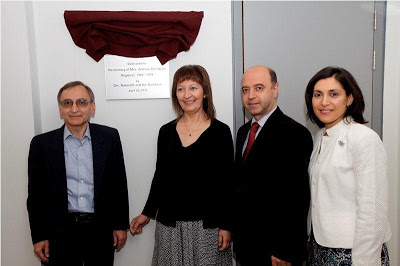
Current Registrar, Mrs. Anahid Fermanian shared her memories with Mrs. Armine Darakjian, as being her direct supervisor when she recently joined the Haigazian family, back in the 70’s.
The event ended with a fellowship reception.
Mira Yardemian
Public Relations Director
The event was attended by Haigazian University Board of Trustees coming from the USA for the annual Board meetings, along with the local Board members, University staff and faculty members.
University President, Rev. Dr. Paul Haidostian gave a short briefing about Mrs. Darakjian’s career as a Registrar at Haigazian University, while the audience had the chance to watch a power point presentation, featuring Mrs. Darakjian’s photos and handwritten documents, meticulously collected from the University archives.
In a moment of emotion, Mrs. Darkjian’s daughter, Dr. Ani Darakjian remembered her beloved mother and expressed her joy and gratitude towards Haigazian University in accepting her donation and placing the plaque in memory of her mother at the entrance of the Admissions Office, in the Heritage Building.
Current Registrar, Mrs. Anahid Fermanian shared her memories with Mrs. Armine Darakjian, as being her direct supervisor when she recently joined the Haigazian family, back in the 70’s.
The event ended with a fellowship reception.
Mira Yardemian
Public Relations Director
ՄԻՋ ՅԱՐԱՆՈՒԱՆԱԿԱՆ ՈԳԵԿՈՉՄԱՆ ՅՈՒՇԱՀԱՆԴԷՍ


Young Men and Women and the Armenian Church Leaders Today
Young men and women, today, are encountering numerous difficulties, be they of Armenian identity, sexuality, discipline, belief, direction, and faith. They are facing these issues almost all by themselves.
On one side, the Armenian church and the mature adult generation is engulfed and busy in their own administrative and urgent problems, whether social issues, financial difficulties of their organizations, schools, churches, to the extent that there is almost no quality time left for mentorship and for Paul-Timothy relationship and for preparing the next leading Christian men and women.
On another side are the young men and women, who are asking questions, are encountering the fast changes happening around them, and are facing luring temptations. They need to find answers to their difficult questions and they have to find them fast.
They are left alone in this battle, the next generation, who is going to take the lead tomorrow in preparing younger Christian men and women, who are faithful in Christ's message, who are ready to share their faith within their community and outside, who are not cast hither and tither where the wind blows. But alas! This is not the reality today. They are out there alone, with almost no accountability, almost no support, almost no guidance.
Vahé Jébéjian's voice is one of the voices of the youth, here in chanitz.org. He is asking difficult, yet important questions. He is trying to find answers to the questions that the youth is asking today.
It is very encouraging to see a young man writing about Christianity, the Christian faith and Christian living.
Admin,
Raffi
On one side, the Armenian church and the mature adult generation is engulfed and busy in their own administrative and urgent problems, whether social issues, financial difficulties of their organizations, schools, churches, to the extent that there is almost no quality time left for mentorship and for Paul-Timothy relationship and for preparing the next leading Christian men and women.
On another side are the young men and women, who are asking questions, are encountering the fast changes happening around them, and are facing luring temptations. They need to find answers to their difficult questions and they have to find them fast.
They are left alone in this battle, the next generation, who is going to take the lead tomorrow in preparing younger Christian men and women, who are faithful in Christ's message, who are ready to share their faith within their community and outside, who are not cast hither and tither where the wind blows. But alas! This is not the reality today. They are out there alone, with almost no accountability, almost no support, almost no guidance.
Vahé Jébéjian's voice is one of the voices of the youth, here in chanitz.org. He is asking difficult, yet important questions. He is trying to find answers to the questions that the youth is asking today.
It is very encouraging to see a young man writing about Christianity, the Christian faith and Christian living.
Admin,
Raffi
What have good people done to deserve Hell?
“Tell them as surely as I, the Sovereign Lord, am the living God, I do not enjoy seeing a sinner die. I would rather see him stop sinning and live” Ezekiel 33:11
Easy, Christians say. They haven’t accepted Christ as their Savior, therefore they deserve death. It’s easy to say it. But what if it happens to someone you knew, well aware that that person had given so much of his/her life to humanity: saving, serving, healing, caring, loving, educating, making people happy, and inspiring people with hope. In other words, they made the world a better place for us and for future generations. What a great and amazing person! This guy has lived his life to the full. He has done it all. He surely deserves the best.
Wait a second.
This person isn’t a believer because he has seen what religion does to people: narrows their vision, prevents them from thinking outside the box, and alienates them from their fellow human beings. What if this person wanted to be free from insularity, closed-mindedness, and detachment from human and scientific progress? Now, can we rightfully say that he/she was a bad person because he/she didn’t believe in the God you believe in?
Let’s get to the heart of the problem: Why doesn’t such a good person believe in God?
You could say that he wanted to exercise free thinking. Maybe he was disgusted by the countless pedophile cases brought against priests. Maybe he was disgusted by divisions in the Church. Maybe he was disgusted by the way Christians look at people who are ‘different’ from them in color, race, language, belief or lifestyle. The list is longer than you might think. The bottom line is that he/she stopped believing in God a long time ago mainly because of the image the Church radiates today.
A devoted Jewish family, whose father was a prosperous businessman, suddenly one Sunday morning decides to go to the Lutheran Church. His little boy asks him, “But why father? Why do we have to go to church today? Aren’t we Jews?” The father replies, “It’s good for business, son”. This little boy grew up declaring openly his disgust with religion. He was the one who said “Religion is the opium of the people”. Yes, he was Karl Marx! Who can say Karl Marx wasn’t a good guy? He had immense influence on philosophy, economy, politics and literature. But, yes, according to Christians he deserves Hell. Why?
He had plenty of time to believe in God, yet he didn’t. The question is: What are we doing to attract people to God?
St. Teresa of Avila writes, “Christ has no body now on earth but yours, no hands but yours, no feet but yours.” Indeed, as Christians we have work to do. We can’t just sit around complaining that people are leaving Christianity behind. We must be God’s true Church on earth.
People have personal, familial, societal frustrations and conflicts. They face daily economic, moral, sexual and psychological challenges. People have valid dilemmas that deserve the Church’s attention. Hearing the pastor preach about abortion, unemployment, adultery, cheating, homosexuality, drug abuse, pornography, Internet addiction, in-law frictions and other daily problems and issues people want to know about will get people closer to Christ! Many questions lie in people’s minds and it is the Church’s duty to answer them. We must have our say in this world. That is Jesus’ last and greatest Commission to the Church.
Indeed, Christ does not wish for people to be lost. He is happy when people serve humankind. After all people like Karl Marx have served humanity, Christ’s own creation. How sad do you get when you lose people you love, especially knowing that they hadn’t accepted Christ as their savior? I’m sure you must feel devastated. God gets even sadder than you. He feels pain more than you can ever imagine! He repeatedly tells us in the Bible how He doesn’t want people to “perish but to have everlasting life”. Timothy tells us, “It pleases God our Savior who wants everyone to be saved and to come to know the truth,” 1 Timothy 2:3-4.
This is not an invitation for the Church to change its values, absolutely not! On the contrary, the Church must talk boldly about today’s issues so that people get their questions answered. And this is how the Church will have a greater impact on peoples’ lives. This is why we are here for: to change people from deep inside so they can come to know Jesus and His wonderful message of salvation.
Next time you hear of a person’s death, don’t say “What a shame he died”. Rather say “What a shame, he could have been a Man/Woman of God”. In today’s troubled world, people need healing. People may seem happy on the outside, but the majority need healing from the inside. And it’s our duty as Christians to help them get that healing with the help of the Holy Spirit.
Be the light that will shine through humanity. Don’t just be a good person but a someone who will serve God no matter the cost. Remember, “The Lord does not want anyone to be destroyed, but wants all to turn away from their sins,” 2 Peter 3:9.
Vahé Jébéjian

Easy, Christians say. They haven’t accepted Christ as their Savior, therefore they deserve death. It’s easy to say it. But what if it happens to someone you knew, well aware that that person had given so much of his/her life to humanity: saving, serving, healing, caring, loving, educating, making people happy, and inspiring people with hope. In other words, they made the world a better place for us and for future generations. What a great and amazing person! This guy has lived his life to the full. He has done it all. He surely deserves the best.
Wait a second.
This person isn’t a believer because he has seen what religion does to people: narrows their vision, prevents them from thinking outside the box, and alienates them from their fellow human beings. What if this person wanted to be free from insularity, closed-mindedness, and detachment from human and scientific progress? Now, can we rightfully say that he/she was a bad person because he/she didn’t believe in the God you believe in?
Let’s get to the heart of the problem: Why doesn’t such a good person believe in God?
You could say that he wanted to exercise free thinking. Maybe he was disgusted by the countless pedophile cases brought against priests. Maybe he was disgusted by divisions in the Church. Maybe he was disgusted by the way Christians look at people who are ‘different’ from them in color, race, language, belief or lifestyle. The list is longer than you might think. The bottom line is that he/she stopped believing in God a long time ago mainly because of the image the Church radiates today.
A devoted Jewish family, whose father was a prosperous businessman, suddenly one Sunday morning decides to go to the Lutheran Church. His little boy asks him, “But why father? Why do we have to go to church today? Aren’t we Jews?” The father replies, “It’s good for business, son”. This little boy grew up declaring openly his disgust with religion. He was the one who said “Religion is the opium of the people”. Yes, he was Karl Marx! Who can say Karl Marx wasn’t a good guy? He had immense influence on philosophy, economy, politics and literature. But, yes, according to Christians he deserves Hell. Why?
He had plenty of time to believe in God, yet he didn’t. The question is: What are we doing to attract people to God?
St. Teresa of Avila writes, “Christ has no body now on earth but yours, no hands but yours, no feet but yours.” Indeed, as Christians we have work to do. We can’t just sit around complaining that people are leaving Christianity behind. We must be God’s true Church on earth.
People have personal, familial, societal frustrations and conflicts. They face daily economic, moral, sexual and psychological challenges. People have valid dilemmas that deserve the Church’s attention. Hearing the pastor preach about abortion, unemployment, adultery, cheating, homosexuality, drug abuse, pornography, Internet addiction, in-law frictions and other daily problems and issues people want to know about will get people closer to Christ! Many questions lie in people’s minds and it is the Church’s duty to answer them. We must have our say in this world. That is Jesus’ last and greatest Commission to the Church.
Indeed, Christ does not wish for people to be lost. He is happy when people serve humankind. After all people like Karl Marx have served humanity, Christ’s own creation. How sad do you get when you lose people you love, especially knowing that they hadn’t accepted Christ as their savior? I’m sure you must feel devastated. God gets even sadder than you. He feels pain more than you can ever imagine! He repeatedly tells us in the Bible how He doesn’t want people to “perish but to have everlasting life”. Timothy tells us, “It pleases God our Savior who wants everyone to be saved and to come to know the truth,” 1 Timothy 2:3-4.
This is not an invitation for the Church to change its values, absolutely not! On the contrary, the Church must talk boldly about today’s issues so that people get their questions answered. And this is how the Church will have a greater impact on peoples’ lives. This is why we are here for: to change people from deep inside so they can come to know Jesus and His wonderful message of salvation.
Next time you hear of a person’s death, don’t say “What a shame he died”. Rather say “What a shame, he could have been a Man/Woman of God”. In today’s troubled world, people need healing. People may seem happy on the outside, but the majority need healing from the inside. And it’s our duty as Christians to help them get that healing with the help of the Holy Spirit.
Be the light that will shine through humanity. Don’t just be a good person but a someone who will serve God no matter the cost. Remember, “The Lord does not want anyone to be destroyed, but wants all to turn away from their sins,” 2 Peter 3:9.
Vahé Jébéjian
ՀԱՅՈՒՆ ՀՊԱՐՏՈՒԹԻՒՆԸ

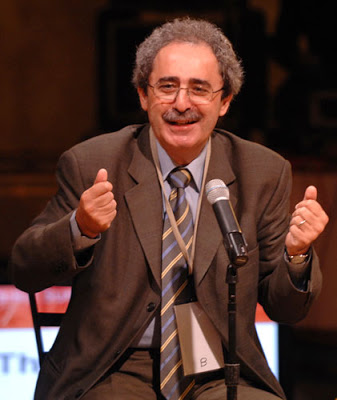
Worship Service for the Commemoration of the Armenian Genocide
On Tuesday, 24 April, the worship service for the commemoration of the 97-anniversary of the Armenian Genocide, took place in the Nor-Marash Armenian Evangelical Church.
Mr. Levon Filian, the Executive Director of AMAA, brought the message. Rev. H. Svajian led the worship, Badveli H. Cholakian read from the Bible, Rev. S. Kilaghbian recited the prayer, and Rev. M. Karagoezian gave the benediction.
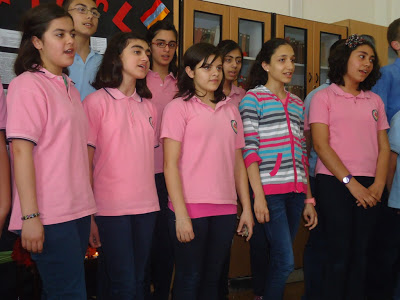
The choir of the Nor-Marash Armenian Evangelical Church sang two hymns, accompanied by Mrs. Y. Kilaghbian, on the piano.

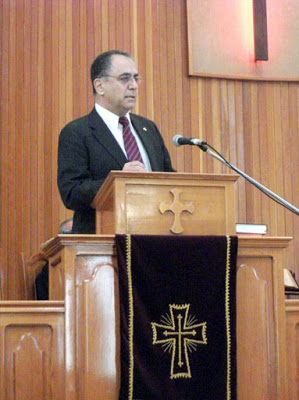
Mr. Levon Filian, the Executive Director of AMAA, brought the message. Rev. H. Svajian led the worship, Badveli H. Cholakian read from the Bible, Rev. S. Kilaghbian recited the prayer, and Rev. M. Karagoezian gave the benediction.
The choir of the Nor-Marash Armenian Evangelical Church sang two hymns, accompanied by Mrs. Y. Kilaghbian, on the piano.

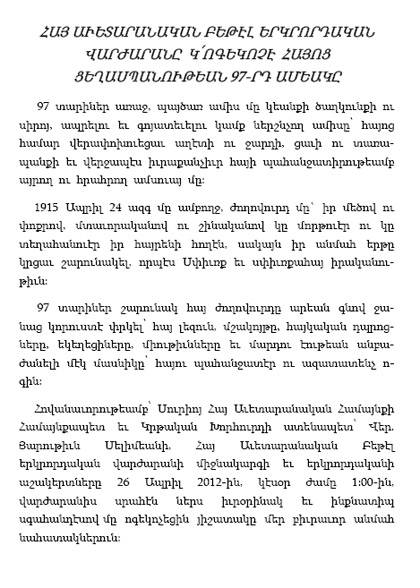
ՀԱՅ ԱՒԵՏԱՐԱՆԱԿԱՆ ԲԵԹԷԼ ԵՐԿՐՈՐԴԱԿԱՆ ՎԱՐԺԱՐԱՆԸ Կ՛ՈԳԵԿՈՉԷ ՀԱՅՈՑ ՑԵՂԱՍՊԱՆՈՒԹԵԱՆ 97-ՐԴ ԱՄԵԱԿԸ


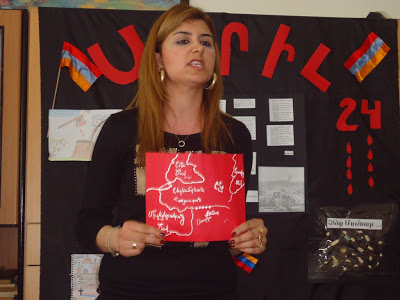
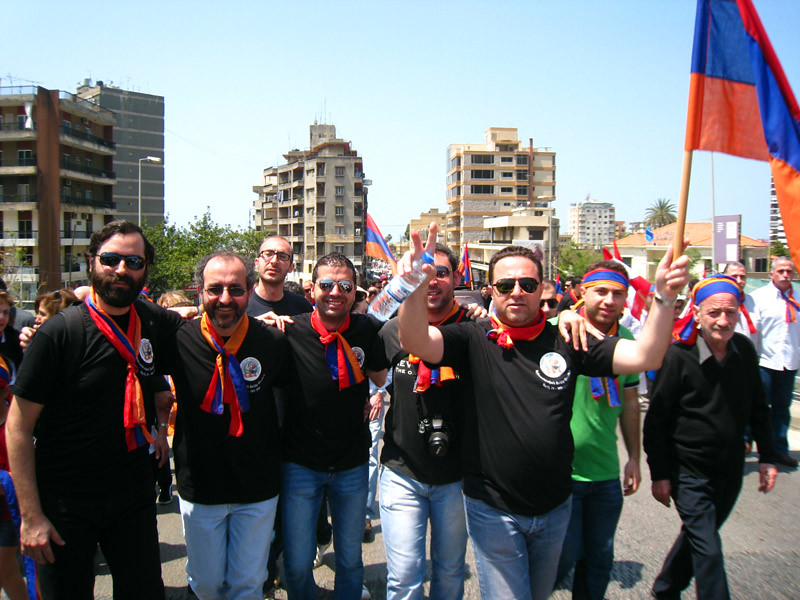
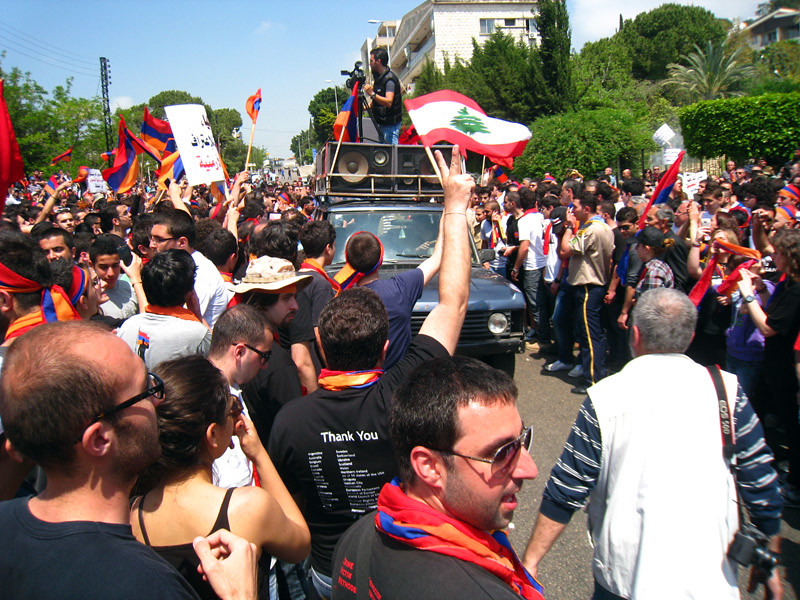
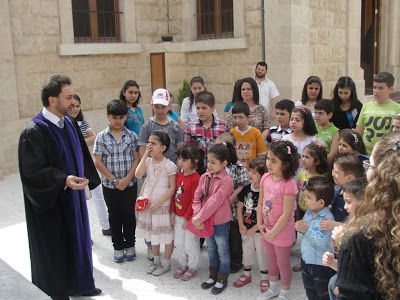
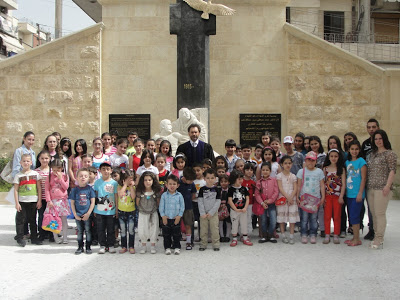
Chanitz Youth March on April 24 for Remembering the Armenian Genocide