“The Lord God has told us what is right and what he demands: ‘See that justice is done, let mercy be your first concern, and humbly obey your God.’” Micah 6:8
I hear many people say, “You know I love God, but I don’t know what he wants for my life. I don’t know how to be a good disciple.”
As followers of Christ we shouldn’t have thoughts like these. Jesus made it pretty clear to us in His Word. Everywhere in the Bible, we see commandments on how to live and be fruitful for God. First of all, the two great commandments (Matt. 22:37-40):
1. Love the Lord your God with all your heart, soul, and mind. This is the first and most important commandment.
2. Love others as much as you love yourself.
Indeed, both commandments seem the easiest thing to do in the world. Love is the most beautiful thing. But who does exactly Jesus refer to by saying “others”? My father, mother, best friend, brother, sister? Yes, but it doesn’t stop there. Some versions use the word “neighbor”. Who exactly is my neighbor? He refers to your enemy, the one that has caused you pain. To go even further, and to enlarge our borders, our neighbor is the little sick and hungry child in Kenya. That is precisely who Jesus was talking about.
Now, you may tell me, “My friend, I’m just a nobody in this world, with no special powers whatsoever.” Let me tell you something, God loves and uses nobodies. Have you ever heard of Agnes Bojaxhiu? Well, neither had I, but this woman is a Noble Prize winner and the founder of the Missionaries of Charity. You might know her as Mother Teresa, who said, “We can do no great things; only small things with great love.” A few years before her death, a journalist asked her, “What will happen, Mother Teresa, when you are no longer with us?” Her answer was: “I believe that if God finds a person even more useless than me, He will do even greater things through her.”
I’m sure you know Paul. But we often forget Saul, Paul’s past, the man who persecuted Christians. He was a nobody, but it’s because of him that the world knows about Jesus. The list is long. Rightly, Bette Reese has said, “If you think you are too small to be effective, you have never been in bed with a mosquito.”
Did you know that there are more than 2000 verses in the Bible that refer to Justice and Poverty. Jesus has blessed us with so many great things so that we can in return help the needy, those who have less than us. In James 1:27 we read, “Religion that pleases God the Father must be pure and spotless. You must help needy orphans and widows and not let this world make you evil.” The Bible is full of such commandments.
Here are some facts for you: 1 out of 4 people is underweight in developing countries; 1 out of 7 people worldwide which means 854 billion people do not have enough food to sustain them. And here you go, 25000 children die of hunger every single day, which makes up more than 9 million children dead per
year. When you put your children to bed tonight, think of those 25000 children who laid down their lives today because they didn’t have what your children have.
You might be thinking, is Vahé aware of what he’s talking about? How in the world can I help all these children? Well, you can’t. However, you can help that one child who’s dying of hunger near you. Next time you pass by him or her, think of this little childs life, and think of how you can help. You would have done a big difference to that child!
This reminds me of the man who was walking on the beach when he saw tens of thousands of starfish lying on the beach, dying. He sat on a rock, crying and weeping for all those lives which were about to end. Then as he was weeping, he saw a man taking a starfish and throwing it back into the sea. The man was puzzled and asked the guy, “Sir, what are you doing? There must be tens of thousands of them here. You can’t throw each one by one back into the sea? There’s no way you can save all of them.” The man looked at him and answered, “It made a difference to that one.”
God doesn’t expect you to do everything. He only expects small things from everyone. He calls you to self-denial, to take up your cross and follow Him.
Do not forget, Jesus came for the poor and the sick (soul and body). He said, “Healthy people don’t need a doctor, but sick people do. I didn’t come to invite good people to be my followers. I came to invite sinners.” Mark 2:17
Indeed, the need for mission should be our third commandment! World Vision once did a survey on pastors to know where they set their priorities. 79% said worship, 55% children’s ministry, 57% evangelism, 47% discipleship. Unfortunately, only 18% considered helping the poor and hungry a priority in their ministry.
This is the essence of our religion as James clearly states. The World needs our help, that’s why Christ came to the World. People must see that followers of Christ are here to change the World, and not to adapt to our World’s way of life.
As Paul instructs Timothy, he does the same to us, “So with God and Christ as witnesses, I command you to preach God’s message. Do it willingly even if it isn’t the popular thing to do. You must correct people and point out their sins.”2 Timothy 4:1-2
Vahé Jebejian








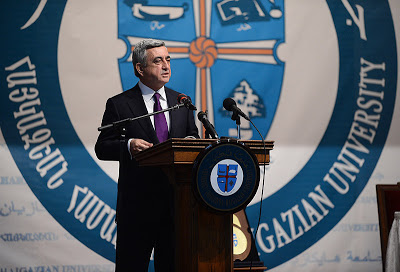
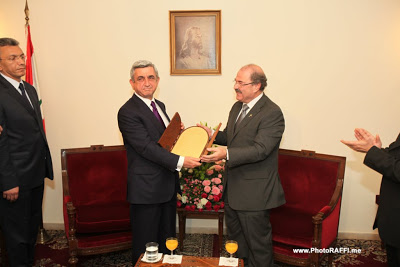
 On Friday, December 7, 2012, within the framework of numerous events commemorating the 500th Anniversary of Armenian Printing and the 100th Anniversary of Armenian Press in Lebanon, Haigazian University honored the current Lebanese-Armenian printing and publishing houses, an event conducted under the patronage of the Minster of Industry, H.E. Vrej Sabounjian.
 President Haidostian appreciated the efforts of the organizing committee for this unprecedented event, the extensive researchconducted in the field of printing and publishing houses. He finally highlighted the contribution the Armenian community has had on the local Lebanese printing industry.