Installation Of The New President: Dr. George F Sabra


(07 October 2012 05:00 pm)

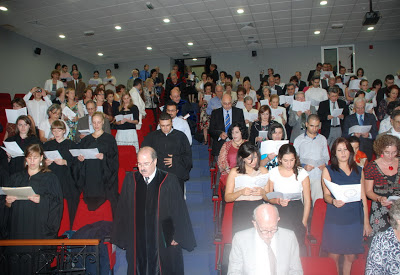
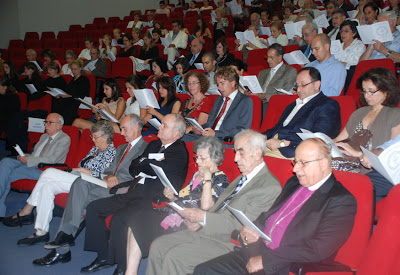
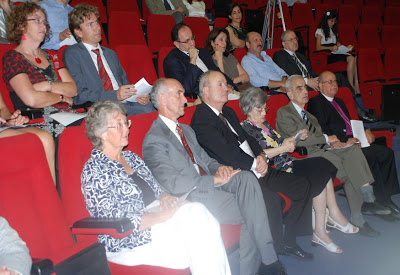
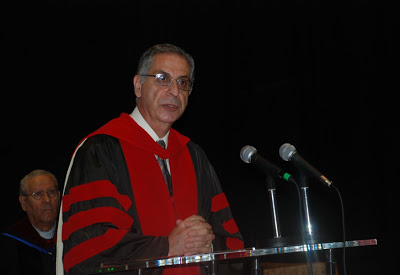
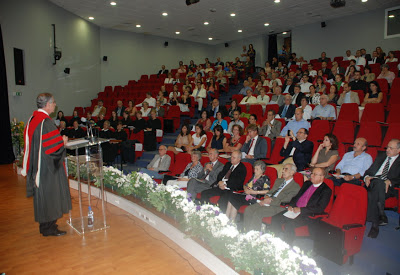
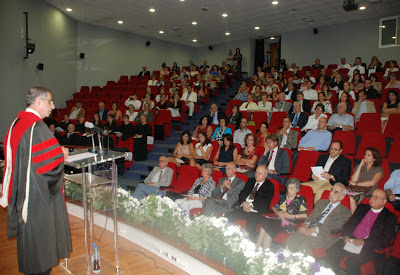
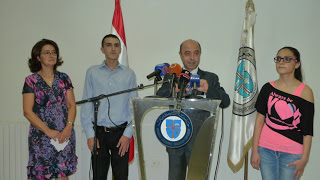
On Sunday, October 7th, The Near East School of Theology celebrated the opening convocation and installment of the ninth president, Dr. George Sabra.  It was attended by students, faculty and staff, board members, representatives of AUB, LAU and Haigazian University, the Arab Baptist Seminary and friends of NEST and was followed by a reception.

A word of welcome was offered by Rev. M. Karaguezian, president of the Union of Armenian Evangelical Churches and secretary of the Board of NEST, and the invocation was given by Rev Zoorob, Pastor of the Episcopal Evangelical Church, Beirut.

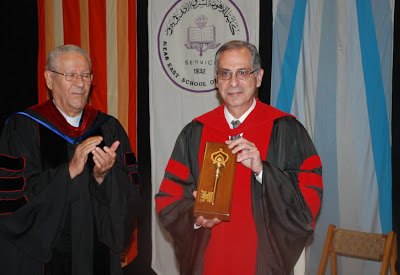
The new president was installed by Rev. Dr Sahiouny, President of the Supreme Council of the Evangelical Community of Syria and Lebanon and Chairman of the Board of Managers, who presented Dr Sabra with the symbol of office.   Dr. Paul Haidostian, president of Haigazian University and Member of the Board of NEST, presented the new president and closed by saying: "I can confidently say, that if Protestantism in the Middle East would have liked to see in a theologian rigor and seriousness, in a teacher clarity and method, in a leader faithfulness and faith, in a preacher concern for the truth, in an administrator, ethical standards and transparency, in a public personality diplomacy and openness, in a Christian believer the rationally minded and soft spirited person, then the name would be our new president, George Sabra.

The charge to the new president was given by Rev. Karaguezian who encouraged Dr. Sabra  saying that although he had been entrusted with its leadership, it was the responsibility of the community to attend to the needs of the NEST together.  He stressed that the NEST community is behind him and with him as we work together to  sustain the school and nurture it in its unique role as a Protestant Theological Seminary and a beacon in the local community and in the wider Middle Eastern region.

In response, Dr. Sabra gave an address on the three tasks of a Theological Seminary.  He reminded and encouraged us that the role and responsibility of such an institution is to serve both the church and the wider community, to cope with change, responding to the challenges that the Church faces by thinking theologically and searching to find Biblical truths that can be applied to our changing world and working together to transform Church and society.

A Prayer for dedication was given by Mr Jahshan, Vice Chairperson of the NEST Board of Managers and readings were given by professor of New Testament, Dr Awwad, and student Gerard Ghazarian.

Music was played by resident Lori Aintablian, on piano and student Lisa Mohns, who conducted the NEST choir.


Small Things with Great Love


Since the beginning of October when I started my second month working at the Howard Karagheusian Commemorative Corporation (HKCC), I ended up everyday spending my commuting time between home and HKCC, praising God that there is a center that dedicates time and space to Armenian drop-out teenagers to keep them safe and out of the streets. Then, I realized that what we, as a team, were doing in HKCC was more than just a job, and that I was given more than just a position in a center. I realized that we were serving, and I was positioned by God to serve with the group of servants who were already there before I came.

When I first came to this conclusion, I thought to myself that I should definitely write about our service in HKCC; further, I suddenly had this interest to find out what God himself says about it, but before I come to the verses, let me introduce you to what we do in HKCC. With its many departments: medical, social, and educational, I will only speak about the educational department where I serve.

In our department, so far twenty two drop-out students of ages varying from 12 to 23 years old attend the center every day from 8:30 A.M. to 1:30 P.M. where they learn English, Armenian, Arabic, arithmetic skills, computer skills, cooking, hygiene, and nutrition , plus they have counseling hours. One of our many goals is leading these kids back to school, and if not successful, giving them the basic skills they need to have a decent future, and nurturing their needs. Above all, we aim for creating a psychologically, physically, emotionally, intellectually, and morally safe environment to keep them out of the streets and away from the sources of any kinds of risks they might encounter.

Spending time with these teens and realizing that we, as teachers and leaders in HKCC, are the only hope these kids have left to: make a change in their lives, help them see that they are worth much more than what they think of themselves, and help them believe that yes, they can be better, all these have helped me realize that we are serving them and therefore serving God Himself, for the Bible says: “Truly I tell you, just as you did it to one of the least of those who are members of my family, you did it to me” (Mathew 25:40).

Furthermore, even while thinking of the purpose of our mission, spending time with these teens is not as easy as it seems, neither is attempting any kind of teaching or education. We literally have teens who have repeated the same class for three times, others who have been in and out of boarding schools, and another who has been expelled from at least three schools. In addition, every one of these precious teens has a case; one has divorced parents, few have a deceased parent (mother or father), few are at risk of attempting suicide, and the list goes on and on…


Though sometimes we get, or better yet they drive us, nervous, angry, lost, upset, confused, and in extreme cases hopeless, and sleepless, I have found, like the song says “love in a hopeless place”. The amount of love and care that my workmates have for these teens can help me understand what Saint Paul meant by saying in Colossians 3:23 “Whatever you do, work at it

with all your heart, as working for the Lord and not for men”. And as if this overflow of love has infected me (positively) to have and share the same amount of love and care for these kids.

Even more, when I first decided to shift my job from being a full time teacher working till 2:30 P.M. to being a full time staff at HKCC working till 6:00 P.M., those close to me mocked me and thought I was partially crazy or perhaps unintelligent or not wise, but my reply to everybody who thinks like that comes from the book of Hebrews 13:16, that says: “And do not forget to do good and to share with others, for with such sacrifices God is pleased”. I guess, all I can say now is that I should be, and am, thankful to God every day that He has given me the chance to do ‘good’ and ‘share’ through HKCC.


To conclude, I would like to share two quotes from two great pioneers in their domains. These two quotes can summarize all the work, the “what”s and the “why”s of our service in HKCC. The first is by Saint Thomas Aquinas, who said “To love is to will the good of another”. And the second, by Mother Theresa who said “We can do no great things, only small things with great love” and that’s what we do in HKCC, small things, just the musts, but with great love!

Aline Tahazian
Aline Tahazian

The Thieves and Divine Mercy


And he said to Jesus, ‘Remember me, Jesus, when you come as King! Jesus said to him, ‘I promise you that today you will be in paradise with me.’ Luke 23:42-43

Jesus had just suffered great hardship and disgrace and been crucified. He was humiliated in public, wore a crown of thorn, not a crown designed with precious stones, gold, diamonds, rubies, no! But it was made out of thorns that pierced His head. He was crucified among thieves. They deserved their punishment, and one of the thieves even admits it, “You received the same sentence he did. Ours, however, is only right,” Luke 23:40-41. Indeed we can see how He felt. Jesus Christ had done nothing wrong, and still they treated Him like any other criminal, they crucified Him with two bandits.

The worst is yet to come.

He was abandoned by His own Father who had sent Him to this Earth to do humankind a favor. We can imagine just how He feels when he cries out to His Father in pain and sorrow, feeling abandoned among people He came to save, “Jesus cried out with loud shout ’Eli, Eli, lema sabachthani?’ which means, ‘My God, my God, why did you abandon me?’” Matthew 27:46. Indeed there had never been such tragic and dark three hours since God had created humankind on earth. Jesus utters here a complaint from Psalm 22. Here he teaches us how Scripture can be used to direct us in prayer and redemption.

Jesus was crucified between two thieves. In them are shown the different effects Christ’s cross has on the children of men in the preaching of the Gospel. One who had a hardened heart didn’t want to believe until the last moment. What an opportunity he had, the Messiah was next to him, crucified, yes, but still next to him ready to forgive him, but all he wanted at that moment was to get rid of his nails.

On the other hand, the other thief rebukes his fellow offender for his attitude when the Messiah is just next to him. The man’s faith is just amazing. We can see this in his prayer, “Remember me, Jesus, when you come as king.” He believed in the life to come, he wanted to be happy later on, knowing that he hadn’t lived the ideal life. He only says, “Jesus remember me,” nothing else. He let Christ decide if he wanted to forgive him or not. What a true repentance that was. We see that in his prayer. He knew that he was a criminal and had done things to people that could not be forgiven. That’s why in his prayer we see that he knows that the man crucified next to Him is the real Messiah who had come to save humankind. Such humility can’t be seen often. He didn’t even beg Jesus for his life, his prayer was sincere.

The truly amazing aspect of this story though is that Jesus answers, “I promise you that today you will be in paradise with me.” Now, at that moment, Jesus was in such agony and distress, betrayed by His Father, feeling such pain that no one else could ever experience, crucified by the ones he had come to save. The amazing aspect of Jesus that we see here is that Christ is the same on the cross, in agony, and on the throne of Glory. He showed such mercy that has never been seen in the history of humankind. How much then should we show mercy to our brother or sister who comes to us with a repentant heart?

Now anyone reading this story might say, “Oh, well, it’s okay then. I’ll live my life the way I want to, do all the things that I wish, even if most of them are against Christ’s teachings, all will be fine in the end, because I can always confess on my deathbed, and God will always forgive me as He forgave that thief on the cross.”

Well, before you get your hopes too high, we should take this case to be a singular one. No one can be sure that they’ll have time to repent at death, and you can be sure that you won’t have the advantages this penitent thief had. Let’s take a look at it.

1. he rebukes the other thief for saying, “Aren’t you the Messiah? Save yourself and us!”

2. he admits that he deserved what he got, “We are getting what we deserve”.

3. he believed that Jesus suffered unjustly, “But he has done no wrong”.

4. he said all this before the amazing events happened: “The sun stopped shining and darkness covered the whole country.”

5. he believed that Jesus was King, and finally most important of all

6. the thief asked for Jesus. His request was, “Remember me, Jesus”. Hence, he was humbled with true repentance, and he brought forth all the fruits for repentance his circumstances would admit.

By his act of grace Jesus teaches us that He came to Earth to open the Kingdom of God to all penitent, obedient believers. “I have come in order that you might have life; life in all its fullness.” John 10:10

Vahé Jébéjian

Bibliodrama (Biblical Drama) In touch with the Bible


The Christian Education Resource Center & Women’s Studies

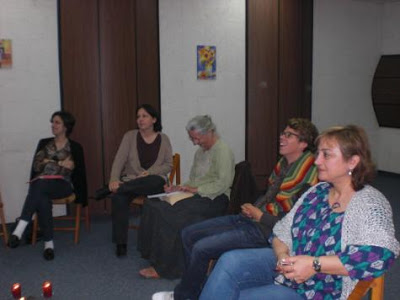
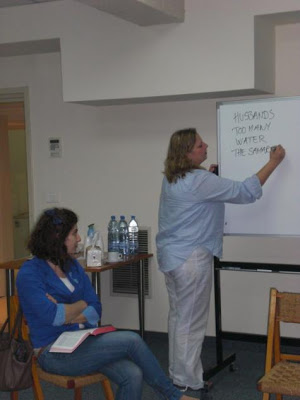
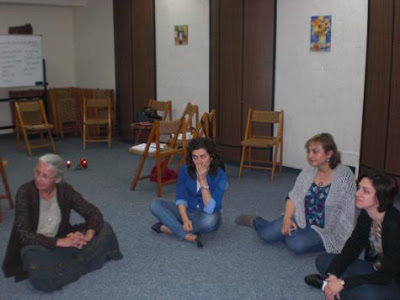
Dear friends and partners in ministry. I would love to share with you about our latest event called Bibliodrama led by Rev. Agnete G. Holm from DanMission, which was held on Saturday, April 28, 2012, from 9:30 a.m. – 12:30 p.m. in the CERC Seminar room at NEST. As requested by Agnete, our number was seven, which is the ideal number for such a group activity.

Bibliodrama is not drama or theater – but it is spiritual counseling in a group with the help of biblical texts. There is a Bibliodrama leader who guides and leads the group through the text and through the issues that appear. Bibliodrama was invented in a Cappuccine monastery in Germany and is inspired by the Ignacian spirituality.

We all know that we learn very much through experiences. But in our churches we are used to sitting down and listening. How can we experience the biblical stories without performing drama or theater? Bibliodrama gives the biblical story a physical place in the room.

The biblical story can be appealing and inspiring, but it does not impose anything on the participants. There is room for the individual to find a place in the biblical story which is relevant and rewarding in life and faith. No matter what, the participants will feel a relation to the biblical passage and there will be room to feel if there is a life-giving calling from the biblical story. The dialogue within the outline is a contemplative listening to the other participants. We listen without commenting and we listen in a way that allows us to focus our attention on what processes are happening in us while we are listening. In the workshop we learn how to make space for this kind of dialogue.


The participants met again after their experiences in the outline, then the session was rounded off with a sharing of faith and experience. This helped us to relate to the experience in a way that is relevant for our life and faith. This was an existential dialogue, where the instructor was present as a spiritual counselor and the participants became companions in each other’s lives. In the workshop we learned to connect our feelings and experiences gained from this spiritual journey to our everyday life.

Here are some of the comments from our participants…

“It was indeed a very meaningful morning! The workshop provided a refreshing way to understand the text: we physically walked with the different characters of the story, we felt their pain and their thirst, shared their questions and were ourselves emotionally touched in our heart and soul. A great way to think creatively about a Bible story and to apply it to our life. Thanks for the invitation C.M.”

“I liked this approach. I had never thought of taking such a journey, it was a new experience to me, and an enriching one. It made me feel really close to Jesus and increased my desire to see my friends really meet him and enjoy his closeness and love. I also want to practice this as I am reading the gospel and try it with the children and maybe one mother or two. Thank you very much for making this happen. H.A.”

“I want to say that in this seminar I gained a new hope for my future. I had the feeling of an essential refreshment and was really impressed by the completely emotional openness of all participants. Thanks for giving me the chance to share this sort of experience with the group! P.R.”

“I would like to tell you that this was the most practical workshop I've ever attended in my whole life ! I was happy to share my thoughts with others and I was extremely relieved, thank God! God bless you. S.J.”

At the end, we had a fellowship lunch in the NEST small dining room and shared more about our experience with Bibliodrama and how effective it is for one’s spiritual journey.


Shaké Geotcherian
Instructor in Christian Education
Director of the Christian Education Resource Center


Trust and Give (2)

1 King 17:7-16

There were three men: a Kharpertsi, a Marashtsi, and an Aintabtsi.
They were out to have lunch together. They decided to eat in an outdoor café. They sat down and ordered soup. Soon three flies came cruising overhead and looked down at those delicious bowls of soup. They all dived bombed down. Each one landed in one of the guy’s soup. So the very proper Kharpertsi took his silver spoon, carefully dipped the fly out of the soup, onto a napkin, folded it, and put it aside.
The Marashtsi grabbed the whole bowl of the soup and went whoof! and blowed the fly out of the soup. Half the soup went out of the bowl and all over the place, but he solved his problem.
The Aintabtsi carefully reached into the soup, picked up the little fly by its wings and said, “I paid for that. Spit it out. All of it.”

God does not work with us this way. He does not force us to be good stewards. God does not want our favors. He does not need our leftovers. God wants to have a relationship with us. He is a God of communication. We tithe and give, because it is a matter of trust and witness to God.

Today I will finish my three sermons by these last four points about stewardship.
I have taken these four ideas from the famous preacher Rev. David Jeremiah. These are the four T’s of which we should be good stewards.

1- TRUTH: The spread of Truth. As stewards of God we are responsible for the truth.
We read in the I Thessalonians 2:4 “…we speak as men approved by God to be entrusted with the gospel. We are not trying to please men but God, who tests our hearts.”

God entrusted us the gospel. As if, God gave you a full house of food. You were entrusted to distribute whatever was given to you. We have responsibility of the gospel message to be distributed- the truth is Jesus Christ and his message. We are entrusted with the gospel.

2- TIME: We are stewards of our time. Time is precious and given by God. We say in Armenian as written by Paul, “Zhamanage dzakhou arek.”

“…making the most of every opportunity, because the days are evil” (Ephesians 5:16).
“We don’t have time.” We keep hearing this. “Badveli, we are in AMERICA.”
Let me tell you about America. Even the ECONOMIST, a secular magazine, is writing about the western lifestyle. The cover of the January 5th issue is : Happiness (and how to measure it). The articles talk about the first world lifestyle, in one word, about us.
Let me quote some sentences: “doing well is not enough: we also want to do better than our peers. This status anxiety runs deep” (p. 34).
“Some fortunate people also found deep satisfaction from losing themselves in their work.” (p. 35).
There is nothing wrong in loving your work; there is nothing wrong in having a good job. But it is dangerous when you “lose yourself in your work.” What a pitiful lifestyle. What are you doing? Ask yourself. What am I doing with my time?
We read in Matthew 12:35, “The good man brings good things out of the good stored up in him, and the evil man brings evil things out of the evil stored up in him.” If you put good in your heart, good will come out. Whatever you deposit, you will eventually get.

How can you put good in your heart? How much time you give to “good”? I cannot find good without God. In order to understand and know more about God, we need time, time with God.

Why not try to change things in your life. Try to tithe your time to God.

3- TALENT: We are stewards of our talents.

We read in 1st Peter 4:10:

“Each one should use whatever gift he has received to serve others, faithfully administering God's grace in its various forms.
I wonder if you know your gifts. You need to know what your gifts are.
Find out your gifts. Read Romans 12 and 1st Corinthians 12. In those chapters, Paul mentions many gifts. Some of you have the gift of mercy, administration, giving, helping … Find out your gift.
Now some of you have the “gift” of criticism. You know Jesus told the parable of talents. One person buried the talent. Please do like that person. The only talent that I will ask you not to invest in, is the gift of criticism.
“Faithfully administering God’s grace,” means our talents should be used for the glory of God and not ourselves.

4. TREASURE: Invest in the Kingdom.
We read in I Corinthians 16:1-2
“Now about the collection for God's people: Do what I told the Galatian churches to do. On the first day of every week, each one of you should set aside a sum of money in keeping with his income, saving it up, so that when I come no collections will have to be made.”
a- Give periodically. What do I mean? “On the first day of the week...” According to Paul, it is important that the church members learn to give periodically. Do not postpone. I train myself to be disciplined in giving. Whenever I receive something, I put aside my tenth. I cannot continue if the tenth is not given to God. Beginning of the week, end, middle, whatever is convenient to you, just learn to give periodically.
b- Each person is responsible. I spoke about it last Sunday. “Each of YOU.” says the word of God. I said this last Sunday, train yourself and your each person in your family to learn to tithe and give to God. Each person is responsible for their life.
c- Give proportionally: “each set aside a sum of money…” We spoke about this.
I will end my sermons with three cases:
Case number one: Once a person came to me in Ainjar and said: “I like to donate my land to the church.” I thanked him. I was wondering why.
“Once Sister Hedvig came to my shop in Beirut and bought some china,” he said. “My two children were there. I asked her if I could send them for one month to the Ainjar boarding school. She accepted. They went and came back after one month. They were different kids. Their behavior was changed. They prayed; they ate anything we gave them; they made their beds; they were polite. I said to my wife, ‘Someday,I would like to donate something to the Ainjar ministry.’ This was 35 years ago. Now I am keeping my promise.”
Case number 2: Once a young man came to me and said, “Here is a young man, a graduate of Haigazian University. He is computer engineer. His business is doing well. He decided to donate $400 to a church.” When he was giving me the cash I told him, “Thank you, but I am more interested in his attendance to church.” He came next Saturday night when Knel Tourian was speaking. Since that day, he did not leave the church. He is one of the leaders of the church and his business is in great shape.
Case number 3: The Ainjar church was being remodeled. We needed every penny for the project. Three kids from the church decided to sell some of their toys. They put on sale their toys and anything they could find. They raised $200.
There are more stories of trusting and giving to God.
You need to act. This is matter of taking action and doing it. Invest in Kingdom Jones. Ask yourself am I robbing God? Am I trusting God and obeying in giving myself to His Kingdom?
The answer is with you

Amen

Rev. Nerses Balabanian,
Calvary Armenian Congregational Church, San Francisco

Haigazian University Launches the Future Armenian Leadership Fund

Haidostian: In this new scholarship program, excellence and leadership potential will receive special prominence.
Beirut, 19 Sept. 2012. On Wednesday, September 19, 2012, Haigazian University officially launched its newly established, the Future Armenian Leadership Fund.
The creation of FALF came as a response from the Haigazian Board of Trustees to the ever increasing need of financial aid for deserving Armenian students. Thus FALF will award academically excellent and financially challenged students with a chance of higher education, covering full or part of their tuition.
At a reception attended by trustees, Armenian educational leaders, and members of the Haigazian community, University President, Rev. Dr. Paul Haidostian thanked the Board of Trustees for establishing the program and the Armenian Missionary Association of America (AMAA) for taking leadership in the fundraising campaign.
Haidostian announced that though a full scholarship grant would require a $25,000, donors may grant any amount for this purpose.  He further disclosed that thus far, $100,000 has been raised, and a fresh $50,000 need to be raised annually, in order for this program to bear good fruit.
Haidostian reiterated the vital importance of the financial aid program at Haigazian University in general, as “one of the most significant contributions the university makes to the future of the Lebanese and Armenian youth.” “More particularly, in this new scholarship program, however, excellence and leadership potential will receive special prominence”, Haidostian concluded.
Recipients of FALF are Armenian students majoring in any subject or scholars majoring in Armenian or Christian Education. Financial Aid Officer, Maral Gurunian declared that the fund, at its first year, granted 2 outstanding students with a full scholarship.  The proud recipients are NanorKalayjian from YeghisheManoukian College and Raffi Kestenian from the Armenian Evangelical College.
The Future Armenian Leadership Fund has been introduced as an opportunity for supporters, alumni and friends of Haigazian to make an impact on one student, helping him/her become a leader in local and global community.
For further inquiry, pls. correspond with the AMAA at amaa@amaa.org

Mira Yardemian
Public Relations Director