The Door

“I am the door. If anyone enters by me, he will be saved, and will go in and out and find pasture,” John 10:9.

The door. What is Jesus talking about here? What door is he talking about? Well, we can be sure that it’s not any door. Indeed, he is comparing himself to a door, and as any door surely this door has a keyhole and needs a key to unlock it. But where is the key to this door? How can we have access to it?

Believe it or not you have the key. Billions of people have it. In what condition is the key? To illustrate, let me tell you a story.

After a wedding service, the pastor gives the couple a Bible as a gift. The couple was very happy about it. Two years later, the pastor decides to pay the couple a visit. The couple was very happy to see him. They said, “Oh, Father! How nice to see you. We still have the Bible you gave us at our wedding. It is very precious for us”. “How nice, let me have a look at it,” said the pastor. He opened a chapter in Matthew and saw the check he had put in the Bible two years ago as a gift for the couple was still there. They had not even opened the Bible.

Indeed the Bible is the key. But how do you use it? Do you do the same thing the couple did? Leave it untouched, under your pillow, lying in the dust in your library or do you wear it off? Yes, many have the key to the door but only some use it. We pray hoping that God will speak to us directly. Well, he does! That’s why he has left us with the key which is just sitting there on your desk.

Can anyone pass through this door? The answer is: No. It doesn’t mean that if you have the key that you can open it. It’s like a key chain. You have many keys on it. The key to this specific door is well marked, yet other keys opening more “interesting” doors distract us. Keys to the delights of this world distract us. Riches, lust, social standing, addictions, the Internet, gadgets consume us. The key is right there in front of us, yet we choose other keys that will give us temporary pleasure.

How wide is this door? Clearly, we have problems to even open it. It is accessible to absolutely anyone. No specific names are written on the door, saying this door is reserved for such and such. Rather “come all of you who seek comfort and justice” is written on it.

We go to church, yet we choose to gossip. Instead of joining the youth group we go clubbing, indulge in smoking, enjoy pornography, and do all sorts of things that distract us from the One who is really worth our attention. We claim to be “good” Christians, following Christ as our leader, yet we choose to disobey our parents, snub their advice, and call them old-fashioned. We claim to be caring, kind hearted, partake of the flesh and blood of our Savior Jesus Christ, yet how fast are we in forgiving our brother or sister? We claim to stand up for justice and peace, yet how quick are we to judge a person by their race, status, and religion?

Jesus said, this door is very narrow. Often we are too preoccupied by opening other doors and forget what our priorities should be and what The Door offers. To your surprise let me tell you what The Door offers: bullying, harassment, singling out, discrimination, persecution, and hatred. The list is long. Sorry to disappoint you. If you want to hear kind words, I’m afraid this article isn’t for you or even Christianity may not be for you.

Christianity is not for weak people. Do you see the cross? It was not nails that held Christ to the cross -- it was Love. I will repeat what my father always says, the cross is made up of two pieces, one which is vertically oriented, representing our relationship with Christ and the other horizontally oriented, signifying that we share what we receive.

The life of a Christian is a daily struggle. A true Christian mustn’t just stay at church surrounded by fellow Christians. Jesus calls every Christian to step out in faith and spread the Good News, proclaiming God’s Glory to all nations. This is faith in action!

The key is there, but how many actually have the courage to choose it from all the other keys? I hope that those reading this will consider this question seriously and meditate on it.

Jesus said, “I am the light of the world. He who follows me shall not walk in darkness, but have the light of life,” John 8:12.

Vahé Jébéjian

Burj Hammoud: treasure trove of culinary delights

BURJ HAMMOUD, Lebanon: Inside the bustling, densely populated narrow streets of Beirut’s Armenian quarters, true culinary gems, each one more enticing than the next, have existed since the Caucasus population fled Ottoman tyranny to safer, less oppressive realms.

The industrial district of Burj Hammoud, northeast of the capital, is not merely home to Lebanon’s Armenian community or migrant workers from Asia and Africa; it is a treasure trove of cultures and culinary traditions.

Scratching beneath the surface, scents of sumac, cumin and garlic mix with those of caramel and vanilla in almost every corner of Burj Hammoud.

Lebanon’s Armenians develop their skills to the point of perfection; they’ll prepare their legendary sujok sausages and basterma meat with the same passion and dexterity as when they create the fine jewelry they are known for.

Crimson-red sausages and cured meat coated with pungent spices hanging next to window displays of flashy jewelry are not completely unfamiliar sights, since in Burj Hammoud, meat retailers, jewelers and other craftsmen perfectly cohabit.

The district’s sujok and basterma can be tasted fresh because in the past decade or two several butchers started sandwich sections.

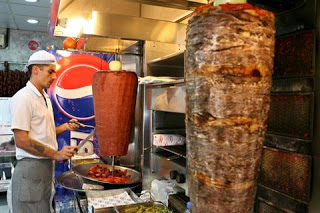
Mano's fusion shawarma sujok is a mix between the traditional shawarma and the sujok sausages. (The Daily Star/Hasan Shaaban)
The Basterma Mano deli on Municipality Street has been the most creative in the field. In addition to traditional specialties such as sujok and basterma sandwiches, Mano borrowed the concept of shawarma and came up with the succulent fusion shawarma sujok, which is served in Lebanese bread on a bed of finely sliced tomatoes and topped with sour wild cucumber pickles.

To extend the Mano experience, think of buying sliced to order basterma from their retail section as well as some old-fashioned golden sandwich bread, “khibz franji” from the Veronna Bakery in close-by Dora for a garlicky dinner the next day.

Mossis is another venue offering a wide range of sandwiches with an Armenian twist. Located on the inner road linking Burj Hammoud to Dora, Mossis is famous for its spicy, paper-thin meat on dough known as lahm baajin, which is rendered even tastier by a squeeze of lemon on top, as well as for its comforting chicken and celery amuse bouche.

Mossis’ roast beef, beef tongue and basterma sandwiches are also widely popular for their taste, which is reminiscent of old times when sandwiches did not drown in an overgenerous slosh of mayonnaise.

If you’re not offered vanilla-scented sweet dumplings with your sandwich at Mossis, make sure to remind the staff about the crunchy deep-fried tubular desert – a real enchantment to the taste buds.

But what about real Armenian home food? Fulfilling dishes such as eetch, the hot version of Lebanese tabbouleh, or manti, the spicy ground lamb mixture in a dough wrapper soaked in garlic yogurt with a generous sprinkle of sumac on top, and sou boreg, the buttered phyllo pastry with a melted cheese filling.

Typical Armenian cuisine, the kind of food you’d have at the home of an Armenian friend, is not served in the capital’s well-known Armenian restaurants but rather in the minuscule low-key chophouses hidden in the maze-like backstreets of Burj Hammoud.

Karnigue Nigolian and his devoted commis/waiter Raffy have been feeding their customers authentic Armenian specialties at the charming 30-seat Restaurant Onno on Aghabios Street facing Sabtieh Church since 1990.
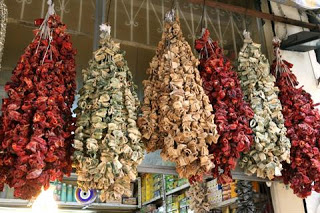
Chillies and other dried vegetables are hung in the Marash Market to make delicious Armenian dishes. (The Daily Star/Hasan Shaaban)

Nigolian, who goes by the nickname Onno, is particularly strict when it comes to reservations, due to the dimensions of his two-story restaurant, decorated with snapshots of pre-Civil War Downtown Beirut.

Onno’s fairly priced menu includes items hailing from Armenian and Lebanese mezze and a lot of arak, of course – the anise spirit is dearly cherished in both cultures.

The fiery chef is especially proud of his sweet and savory kebab bi karaz (cherry kebab), which he serves up with toasted nuts and fried bread.

Onno, in fact, nails the recipe: The gooey dark red cherry chutney is satisfyingly sweet and the lamb kebab tender and juicy.

Onno confides that he shops for his meat, vegetables and most of the remaining ingredients inside Burj Hammoud. One street in particular will definitely delight every foodie.

Souk Marash is the home of spices and other materials required to concoct flavorsome Armenian and other cuisine.

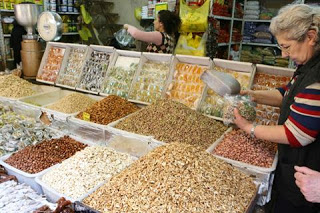
Bulk spices and seasonings, and also dried fruits, nuts and candy are displayed on stands throughout the packed market, which is located parallel to Arax Street, Burj Hammoud’s shopping hub.

The Marash Market will delight every foodie. (The Daily Star/Hasan Shaaban)
At the spacious Bann Garo store right in the middle of Marash, dried black cherries, an essential ingredient for kebab bi karaz, are sold, but also a wide variety of cayenne pepper, chilli paste, and walnuts to make the piquant muhamara dip.

Sweet sujok, the Armenian version of the Lebanese malban sweet, is a bestseller at Bann Garo too.

Sold on wooden skewers, the sweet sujoks can be the perfect ending to a culinary journey in Burj Hammoud. The caramel-scented sweets are made with grape molasses, flavored with rose water and mastic and stuffed with a variety of nuts, including walnuts and pistachios.

And just like Burj Hammoud was once a comforting refuge for newcomers, in Marash, one is likely to find comforting infusions and herbal teas to calm the indigestion incurred after a heavy meal in the lively district that never fails to enchant inhabitants and visitors alike.

Source: DailyStar

SEEING THE RISEN CHRIST


Քրիստոս Յարեաւ Ի Մեռելոց,
Օրհնեալ Է Յարութիւնը Քրիստոսի

KRISDOS HARYAV I MERELOTZ,
ORHNIAL E HAROUTYOUNE KRISDOSI

A Useless Tomb

John 19:38-42
John 20:1-18

2- The cross is empty.

During the Battle of Waterloo, a man used to stand on top of a great cathedral in London. His job was giving news updates from the battlefield to the people. Although there was no telephone communication, there were flags that passed on messages from one tower to another.
The city of London was anxious about the result of the war against the French. Did they defeat Napoleon? This man was standing on Cathedral watching for signals from the battlefield. When the message reached him, he waved his flags to inform the people of London. To their surprise, people read the following, “Willington defeated.” They could not believe it and were very disappointed. However, as you all know, London is famous for its fog. So after a while, when the fog was gone, the man on the tower was able to read and pass on the whole sign: “Wellington defeated Napoleon.” London started cheering and celebrating.

On Friday, Jesus was on the cross.
On Friday, the cheering stopped.
On Friday, there was a “heavy fog”.
On Friday, we saw a Son of God crucified.
On Friday, we thought we were defeated.
On Friday, there were tears
On Friday, there was a funeral, an expensive one.
On Friday, Satan was happy, yet he did not know he was defeated.

All this was on Friday.
Today is Sunday.
Brothers and sisters, the cross is empty.
In our reformed theology, we do not keep Jesus hanging on the cross. Why? Because Jesus is not on the cross anymore, the cross is empty.
The question is, Why do we have empty crosses on alters and everywhere?
It will remind us that God did send His Son so he will be crucified for our sins. The cross is empty. Jesus is resurrected.
Cross is a cruel instrument for punishment. It reminds us that the Son of God was beaten and tortured for us. I would like to see a cross that has nails but no Jesus. Nails will remind me that Jesus Christ the Son of God was broken and beaten for you and me.
He took it all on Himself, in order that we might not have it.
The empty cross reminds me that we are free from the past. It is liberation from our old life.
An empty cross testifies of a terrible tragedy transformed into joy and into victory.
The empty cross reminds us of the words of Jesus on his prediction about the temple. He is the new temple. We read in John 2:19, “Jesus answered them, "Destroy this temple, and I will raise it again in three days."
Yes, it was “destroyed”. Yes, it was Friday and he was crucified; but the cross is empty. The “new Temple”, Jesus Christ, the King of Kings is not on the cross any more. The temple was rebuilt.

3. Finally, the Tomb is Empty

-Last week I told you about the tomb of Napoleon. Not much can be said, He was just buried in a lovely spot near a spring, shaded by two weeping willows. ‘Here Lies’ was written on his stone, no name!
-Millions of Muslim pilgrims go to Mecca for the pilgrimage. Part of their ritual is to walk around Mohammed’s tomb called Al Kaaba. Prophet Mohammad said to have been buried there. The tomb is not empty.
-We Christians do not have a tomb for Christ anymore. Whatever Joseph of Arimathea offered was short term and temporary gift for Jesus. The expensive tomb was useless.

What does it mean to have an empty tomb?
This testifies that the promise of God was fulfilled.
The tomb is empty, that means the gospel message is alive and true.

Paul is right. If there is not resurrection, if the tomb is not empty, what are we doing here?
“…if Christ has not been raised, our preaching is useless and so is your faith. 15More than that, we are then found to be false witnesses about God, for we have testified about God that he raised Christ from the dead. But he did not raise him if in fact the dead are not raised. 16For if the dead are not raised, then Christ has not been raised either. 17And if Christ has not been raised, your faith is futile; you are still in your sins. 18Then those also who have fallen asleep in Christ are lost. 19If only for this life we have hope in Christ, we are to be pitied more than all men.” (1 Cor. 15:14-19)

Life is stronger than death.
The empty tomb shows that whoever believes in Christ will also be saved, delivered from sins, and one day resurrected. An empty tomb means new life, everlasting life.

An empty tomb also indicates that salvation is through the resurrected Jesus Christ. Jesus is not just a moral teacher; he is not just a rabbi; he is the Son of God who came to die on the cross and be resurrected for our salvation. This means sin is defeated.

I am not a Warriors fan. Last year they finished the season with good results. I remember a Bay Area fan who became very excited with the results. He thought they needed a slogan, a phrase that could empower the crowd. He designed yellow T-shirts with the following writing: “We believe” and sold thousands of them to the fans.

Last Thursday, I visited the 92-year-old Sam Yeremian. He was very weak. He could hardly speak. Hartley and I were there with him, encouraging him. We gave him the Holy Communion. He was suffering from high fever. As we were leaving and saying goodbye, he looked at me as his eyes were trying to give me a message. When I came closer to him, he said in Armenian, “Krisdos haryav” (Christ is risen). He was weak and facing physical problems. He did not talk much but he wanted to say the most important words, “Krisdos haryav.”

We believe. Christ is risen. I believe. Do you believe?
Christ defeated the death. The tomb is useless, the cross is empty, the tomb is empty. Do you believe?
Amen


Rev. Nerses Balabanian,
Calvary Armenian Congregational Church, San Francisco