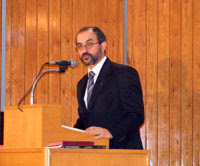
“Ecumenism is a quality of life that needs to be articulated in all aspects of a Christian’s life”, and “conciliarity is an essential nature of the church,” said Catholicos Aram I, head of the Holy See of Cilicia of the Armenian Apostolic Church. He was speaking to the audience at the World Council of Churches (WCC) consultation in Beirut, Lebanon.

Participants of the WCC consultation on “conciliar ecumenism” in Lebanon, 2012. © Photo Markar/Armenian Catholicosate of Cilicia
The consultation was hosted by the Middle East Council of Churches (MECC) from 5-11 February.
The consultation focused on the theme “conciliar ecumenism”, referring to the Christian councils and associations that pursue church unity at the national, regional or world level.
The meeting was attended by thirty-three leaders from national councils of churches (NCCs) and regional ecumenical organisations (REOs), building on the tradition of the WCC, REOs and NCCs working together to give expression to churches’ desire for unity in Christ.
Catholicos Aram I also identified three distinctive trends that require further consideration in conciliar ecumenism, namely the growing shift from church-centred to people-centred ecumenism, a shift from multi-confessional to confessional ecumenism, and a shift from global to regional and local ecumenism.
Other realities, such as the multiplicity of ecumenical actors, churches not yet identifying with the ecumenical movement, and questions of financial sustainability of councils, were identified by the Rev. Dr Olav Fykse Tveit, the WCC general secretary, during his presentation.
Tveit encouraged the participants to ask “if we are really the fellowship of churches that we are called to be, communities of churches that move forward towards the goal of visible unity?”
“And are we a common witness in the spirit and ethos of koinonia and guided by its values, such as solidarity, mutual accountability and the commitment to consensus and common witness?”
Koinonia is the New Testament vision of unity within the communion of the Holy Spirit.
In their responses participants focused on the theological and biblical basis of conciliar ecumenism, reflecting on its different expressions and implications for the role of national and regional councils.
Working together
They also pointed out the sociocultural and geopolitical issues including migration, a context where Christians are called to be witnesses. These issues were also addressed in a presentation by the Rev. Dr Michael Kinnamon, theological consultant for the meeting.
Fr Dr Paul Rouhana, general secretary of the MECC, spoke to the consultation about the challenges faced by his council due to the political turmoil in the region. But he emphasized the potential of churches working together to offer a witness of peace and unity to all.
Along with the group discussions, panels and sessions, participants also benefited from a shared spiritual life in Bible studies, prayers and songs.
“This meeting had several objectives,” said Natasha Klukach, WCC programme executive for North America. “There was urgency to address the very real challenges faced by councils throughout the world and to study together the basis and role of conciliar life within the ecumenical movement.”
“It was also important to build the fellowship and collegiality of this unique group of council leadership. Meeting in the Middle East was both a return to the land in which our faith is rooted, but also a valuable opportunity to focus our conversations by learning from our brothers and sisters in this region,” said Klukach.
A comprehensive report on the consultation, including future vision and recommendations for councils, will be commended to all associate councils of the WCC for study and reflection.
Source: WCC
Participants of the WCC consultation on “conciliar ecumenism” in Lebanon, 2012. © Photo Markar/Armenian Catholicosate of Cilicia
The consultation was hosted by the Middle East Council of Churches (MECC) from 5-11 February.
The consultation focused on the theme “conciliar ecumenism”, referring to the Christian councils and associations that pursue church unity at the national, regional or world level.
The meeting was attended by thirty-three leaders from national councils of churches (NCCs) and regional ecumenical organisations (REOs), building on the tradition of the WCC, REOs and NCCs working together to give expression to churches’ desire for unity in Christ.
Catholicos Aram I also identified three distinctive trends that require further consideration in conciliar ecumenism, namely the growing shift from church-centred to people-centred ecumenism, a shift from multi-confessional to confessional ecumenism, and a shift from global to regional and local ecumenism.
Other realities, such as the multiplicity of ecumenical actors, churches not yet identifying with the ecumenical movement, and questions of financial sustainability of councils, were identified by the Rev. Dr Olav Fykse Tveit, the WCC general secretary, during his presentation.
Tveit encouraged the participants to ask “if we are really the fellowship of churches that we are called to be, communities of churches that move forward towards the goal of visible unity?”
“And are we a common witness in the spirit and ethos of koinonia and guided by its values, such as solidarity, mutual accountability and the commitment to consensus and common witness?”
Koinonia is the New Testament vision of unity within the communion of the Holy Spirit.
In their responses participants focused on the theological and biblical basis of conciliar ecumenism, reflecting on its different expressions and implications for the role of national and regional councils.
Working together
They also pointed out the sociocultural and geopolitical issues including migration, a context where Christians are called to be witnesses. These issues were also addressed in a presentation by the Rev. Dr Michael Kinnamon, theological consultant for the meeting.
Fr Dr Paul Rouhana, general secretary of the MECC, spoke to the consultation about the challenges faced by his council due to the political turmoil in the region. But he emphasized the potential of churches working together to offer a witness of peace and unity to all.
Along with the group discussions, panels and sessions, participants also benefited from a shared spiritual life in Bible studies, prayers and songs.
“This meeting had several objectives,” said Natasha Klukach, WCC programme executive for North America. “There was urgency to address the very real challenges faced by councils throughout the world and to study together the basis and role of conciliar life within the ecumenical movement.”
“It was also important to build the fellowship and collegiality of this unique group of council leadership. Meeting in the Middle East was both a return to the land in which our faith is rooted, but also a valuable opportunity to focus our conversations by learning from our brothers and sisters in this region,” said Klukach.
A comprehensive report on the consultation, including future vision and recommendations for councils, will be commended to all associate councils of the WCC for study and reflection.
Source: WCC