The Legacy of Being the First


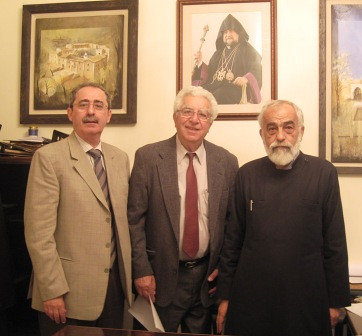
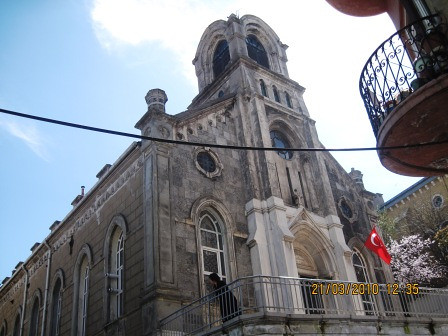
Istanbul, March 2010: As I climbed the stairs of the Armenian Evangelical Holy Trinity Church in Beyoghlou, Pera, Istanbul, I felt as if I were climbing through the stairs of history. I could feel the passion and vision of our forefathers who laid the foundation of the Armenian Evangelical movement in 1846. The Holy Trinity in Beyoghlou was the result of the same passion, being the first Armenian Evangelical Church in Istanbul and the entire world.
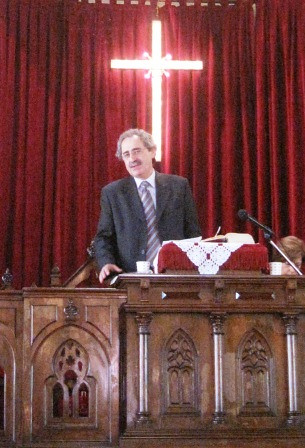
The Church still maintains its historical building, pulpit and chairs, but most of all, it still retains the spiritual enthusiasm of the past. The small congregation, under the leadership of the Council Chair, Mr. Hovhannes Torkomoglou, and lay preacher, Mrs. Sona Ozpenbe, is making sure that the Word is preached every Sunday and made available to the Armenian community in the country.

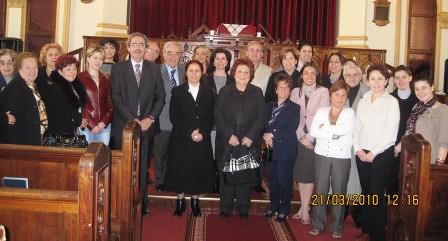
While preaching there on Sunday, March 21, I surveyed the faces of each and every parishioner. I saw their commitment to serve Christ, His Church and the community, acommitment deeply rooted in history and alive today. It was carried over the years with even more passion to be a living witness for the Lord.
Mr. Hovhannes Torkomoghlou has been faithfully leading the church over the past several years. He has been one of the safeguards of the Church and keen not only to “keep the fort” but to do more. “I am 74 years old and have lived my life,” says Mr. Hovhannes. Even so, Mr. Hovhannes still serves the Church with a vision for the future.


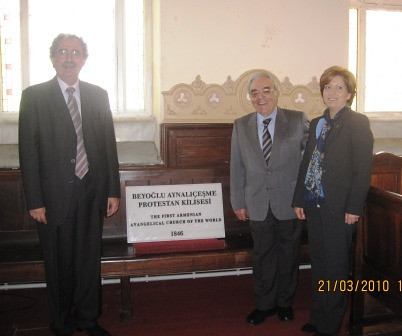
The lay preacher, Mrs. Sona Ozpenbe, has been preaching the Word of God every Sunday and providing pastoral care on a voluntary basis for the last ten years. Mrs. Ozpenbe considers her service a “calling”, a calling to serve the Armenian community through the Holy Trinity Church. The Church has prepared a plaque that will be placed at the entrance of the Church building. The plaque reads: “Armenian Evangelical Holy Trinity Church - The First Armenian Evangelical Church in the World”. As I looked at the plaque, the Church building and the faithful parishioners, I could see the torch of the Mission still illuminated and eager to do more. This, indeed, is the legacy of being the first.


Hrayr Jebejian
We are Easter People


Nicosia, April 2010: “We Armenians are Easter people”. This is how Rev. Dr. Vartkes Kassouni
challenged the Armenian community during the Armenian Evangelical Church Easter service held in
Nicosia on April 3, 2010.
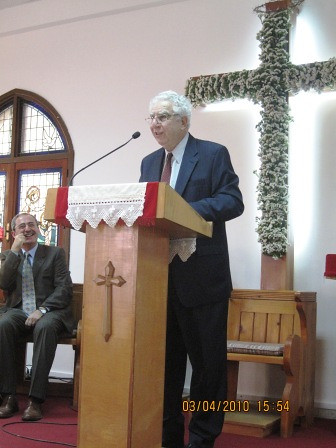
Rev. Kassouni’s sermon was based on Acts 2: 22-24: “But God raised him up, having freed him from death, because it was impossible for him to be held in its power”. He said, “Today, we are among you for exactly the same reason. The Risen Lord has made us alive with him, and we have lived a life of witness and celebration of that fact, beginning in Cyprus and literally taking us around the world with this glorious message”.
Rev. Kassouni’s message was a challenge to be “energized by the Easter Faith because we are Easter people”. He then concluded, “We commemorate today the 95th year of the Armenian Genocide,. Something much more powerful than human strength has carried us through the hell of genocide to the new life in 2010, to which we are all witnesses today. It is the living Christ who first descended into hell and then he rose the third day”.
Mr. Hrayr Jebejian led the service. Mrs. Lynda Kassouni-Walker (Rev. Kassouni’s daughter) and her husband, Mr. Steve Walker (on guitar), together with Rev. Kassouni sang a beautiful hymn. Vahe Jebejian led the hymn singing on the piano, and Alik Jebejian offered a musical piece on the flute from Haydn. Memorial testimonies were also held during the services for two family members who went to be with the Lord, Mrs. Khatoun Barsoumian and Mr. Varouj Chirkinian.


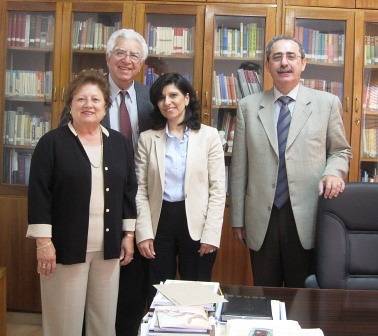
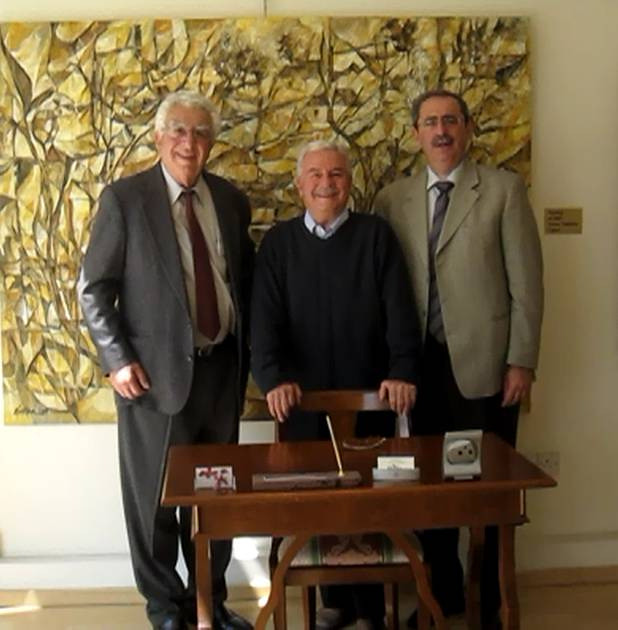
During his stay, Rev. Dr. Vartkes Kassouni had the opportunity to meet with the leadership of the Armenian community in Cyprus. He was a guest in the home of the Armenian Representative in the Cyprus Parliament, Mr. Vartkes Mahdessian. He visited the Armenian Prelacy and met the Prelate, His Eminence Archbishop Varoujan Hergelian. He also visited Nareg School in Nicosia and
met with the headmaster, Mrs. Vera Tahmazian. Rev. Kassouni also met with painter and educator, Mr. Vartan Tashjian. Mrs. Sossy Der Torossian interviewed Rev. Kassouni and broadcast it from the Armenian program of the Cyprus Broadcasting Corporation on Saturday, April 10.
This was Rev. Kassouni’s first “come back” to his own community in Cyprus since he left for the US 60 years ago. Rev. Kassouni was born in Larnaca, studied in the American Academy and immigrated to the US to pursue his theological training. He has served in a number of Armenian Evangelical churches and para-church organizations in the US as well as within local constituencies.

Hrayr Jebejian

Theologians draft manifesto for church unity and justice

[ Rev. Raffi Messerlian, (the pastor of the Armenian Evangelical Church of Anjar), and Ms. Shaké Geotcherian, (member of the Armenian Evangelical Emmanuel Church), both will be representing the UAECNE (Union of the Armenian Evangelical Church in the Neast East) ]

Theologians draft manifesto for church unity and justice

An international panel of pastors and theologians is drafting a “manifesto” on church unity and social justice for a new global organization of Reformed churches. The text is to be presented in June to the Uniting General Council (UGC) of the World Communion of Reformed Churches (WCRC) in Grand Rapids, United States.

At the conclusion yesterday of a four-day consultation in Cartigny, Switzerland, the group representing churches in eight world regions approved a text calling for a clear commitment to church unity as the basis for joint action on economic and ecological justice concerns.

“What we are preparing is in effect a theological manifesto,” says Ofelia Ortega of the Presbyterian Reformed Church in Cuba who chaired the consultation. “Our intent is for UGC delegates to discuss and accept the theological foundations for joint church action in this new communion.This ‘manifesto’ will be a key element to those discussions.”

The UGC will mark the merger of the World Alliance of Reformed Churches (WARC) and the Reformed Ecumenical Council (REC), two branches of the Reformed church family which have traditionally represented differing theological perspectives on the role of churches in society.

“It is clear that in order for churches to work together, they must understand and respect each other’s theology,” says Douwe Visser of the World Alliance of Reformed Churches (WARC) which organised the consultation.

“At the same time, in order to act responsibly on justice concerns, we must have a solid understanding of theology,” Visser adds.

The Cartigny consultation focused on a review of the results of a series of regional consultations held with the support of the Swiss-based Fondation pour l’aide au protestantisme réformé (Foundation for Reformed Protestantism) which supports projects of Reformed churches worldwide.

Throughout 2009 and in early 2010, groups of theologians and pastors met in Europe, Asia, Africa, North America/Caribbean, Latin America, the Pacific and the Middle East to review the theological basis for unity among Presbyterian, Reformed, Waldensian, Congregational, Uniting and United churches.

“Each regional group identified a clear link between church union - or 'communion' as we call it - and action on issues such as gender equality, protection of the environment and a more just economic system,” says Visser. “We believe this understanding must be foundational to WCRC.”

Visser, a former REC world president, says that despite the diversity of theological perspectives among participants in the regional consultatons, it was clear how much the two branches of the Reformed church movement have in common. “This is a strong impulse for moving forward,” he says,

The new organization will have two principal objectives: a focus on continuing to develop the theological basis for inter-church cooperation (referred to in church circles as “building communion”) and a focus on encouraging joint church initiatives in support of the economic rights of vulnerable peoples and the sustainable use of natural resources.

Participants in the Cartigny consultation were: Ofelia Ortega (Cuba), Clifton Kirkpatrick (United States), Setri Nyomi (Switzerland), Serge Fornerod (Switzerland), Rimas Mikalauskas (Lithuania), Raffi Messerlian (Lebanon), Carola Trón (Uruguay), Mery Kolimon (Indonesia), Bridget Ben Naimah (Ghana), Yvette Noble-Bloomfield (Jamaica), Marie Ropeti (New Zealand), and Kim Kyung-In (Korea).


For information about the Uniting General Council, visit www.reformedchurches.org


***
The World Alliance of Reformed Churches (WARC) brings together 75 million Reformed Christians in 214 churches in 107 countries - united in their commitment to making a difference in a troubled world. The WARC general secretary is Rev. Dr. Setri Nyomi of the Evangelical Presbyterian Church, Ghana. WARC's secretariat is based in Geneva, Switzerland.

Full-time Pastor but only Part-time Follower of Jesus

Although this was the title of an article directed to pastors printed in Leadership Journal, I thought this is an important topic to bring forth. As a pastor doing pastoral service as a job, I can fall in the trap of becoming a part-time follower of Jesus. Looking good from the outside, doing all the pastoral duties I have been assigned, I am vulnerable to become empty inside. How long one can continue to be a pastor, an elder, or a leader without being really fed?
Lately we finished our walk through Peter’s 1st Letter. In the 5th chapter, Peter encouraged the elders to be shepherds of the flock.
“To the elders among you, I appeal as a fellow elder… be shepherds of God's flock that is under your care, serving as overseers—not because you must, but because you are willing, as God wants you to be”(1,2). One of the most important tasks of a shepherd is to feed his flock. As elders, as Sunday school teachers, as leaders in the church, we need to feed our flock with the Word of God. But we cannot do this unless we are fed ourselves. Three times Jesus asked Peter, “Do you love me?” After hearing his positive response, Jesus commanded, “Feed my sheep.”
Full-time “Christian” and part-time follower of Jesus is a deceiving concept. It is like the fig tree which has big green leaves, but no fruit. One of my favorite verses in the Bible is in 1st Samuel. “The LORD does not look at the things man looks at. Man looks at the outward appearance, but the LORD looks at the heart” (16:7).
As you see in the picture, there is mask covering the face of the person. The outside appearance is deceiving, but whatever is happening in the heart matters to God. God looks at your heart.

May God lead you to renew your commitment to be “a full-time follower of Jesus.” This means Jesus is real in your daily life. T his means you glorify His name in your daily decisions. This coming five weeks we are preparing us as a church to walk with Jesus in his steps to Calvary. As we look forward to Palm Sunday and Easter may our path to the cross take us towards a new commitment in being his genuine and full-time followers.

Rev. Nerses Balabanian,
Calvary Armenian Congregational Church, San Francisco

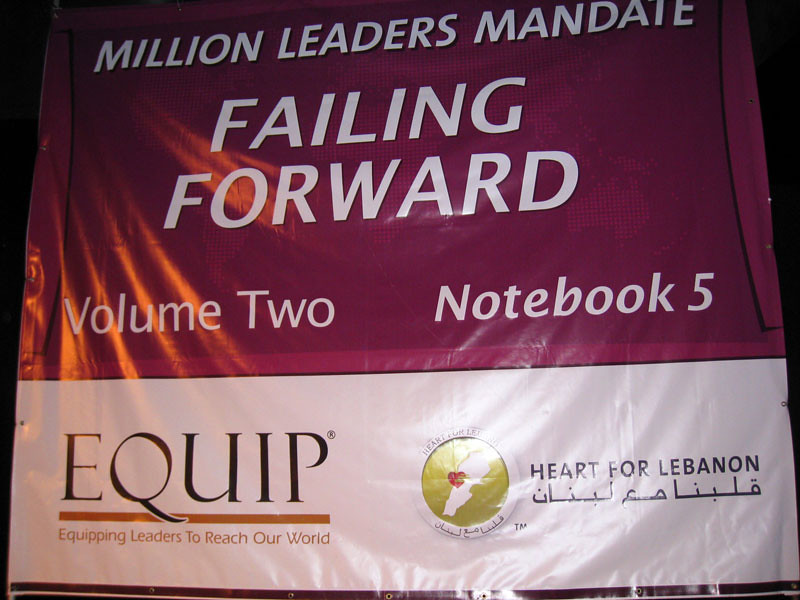
EQUIP Leadership Training, Volume II, Notebook 5 - FAILING FORWARD

The participants came from Syria and Jordan to Lebanon, to Harissa, where the sessions took place on April 23, and 24.
Rev. Camille Melki, is the coordinator of the event and his team had the event well organized. Mr. Tom Atema, the speaker presented most of the lessons, and assisting him was Rev. Khalil, from Jordan, who presented some of the lessons.

The title of the Chapters were:
1- Failing Forward
2- Rethinking Failure
3- Failure Is an Inside Job
4- Turn Adversity into Advantage
5- Make Failure Your Best Friend
6- The Power of Persistence

Participating from Lebanon were:
Ms. Shake Geocherian (Emmanuel Church),
Mr. Serop Ohanian (Emmanuel Church),
Mrs. Jimmy Kozman-Ohanian (Emmanuel Church),
Mr. Mano Chilingirian (Emmanuel Church),
Mr. Raffi Chilingirian (Emmanuel Church),
Ms. Silva Chilingirian (Marash Church)
Rev. Hagop Sarkissian (First Church).

Due to the fact that the 2nd day of the training coincided with the April 24 Remembrance Day of the Armenian Genocide, many Armenians were not able to participate in the 2nd day, also Armenian pastors from Syria were not able to come to Lebanon, because of their duties and obligations.


The difficult yet essential subject of Failing Forward


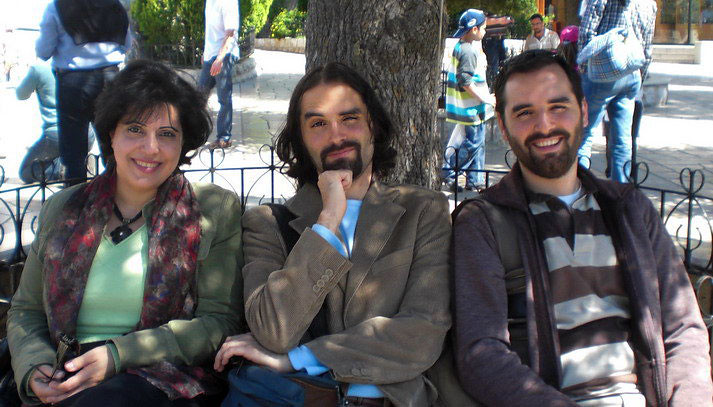
Shaké, Manoug, and Raffi


The beautiful scene and view from Harissa