
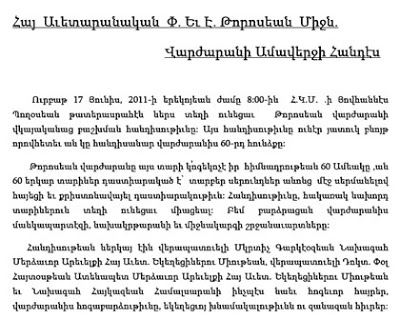
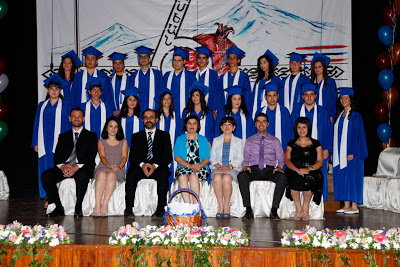
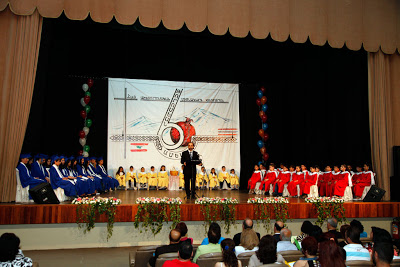

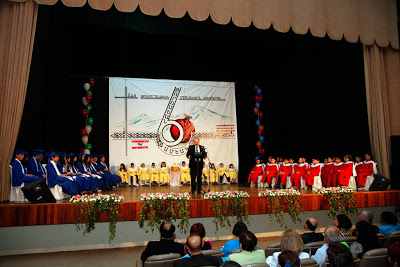
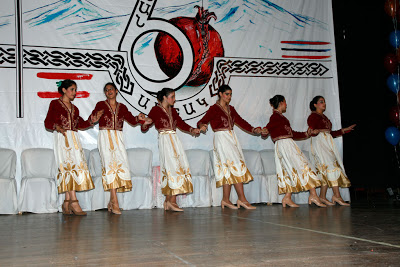
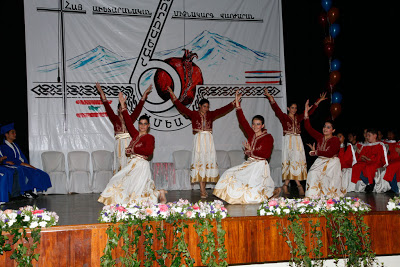
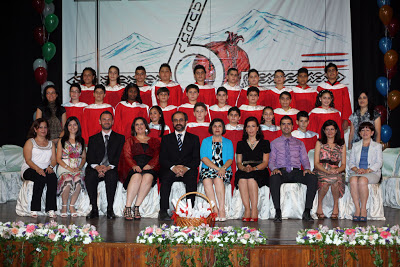
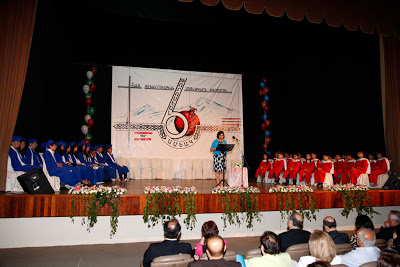
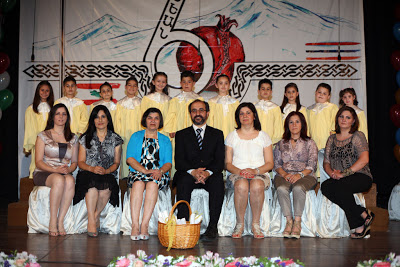
Մային 28-ո Առթիւ Մրցանքներ Հայ Աւետարանական Բեթէլ Երկրդ. Վարժարանէն Ներս


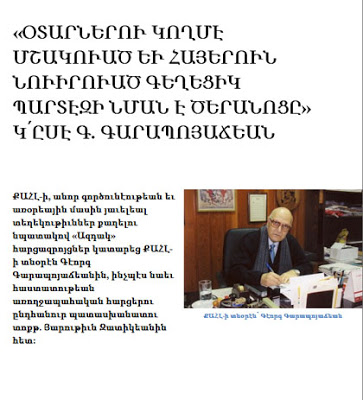
«ՕՏԱՐՆԵՐՈՒ ԿՈՂՄԷ ՄՇԱԿՈՒԱԾ ԵՒ ՀԱՅԵՐՈՒՆ ՆՈՒԻՐՈՒԱԾ ԳԵՂԵՑԻԿ ՊԱՐՏԷԶԻ ՆՄԱՆ Է ԾԵՐԱՆՈՑԸ» Կ՛ԸՍԷ Գ. ԳԱՐԱՊՈՅԱՃԵԱՆ
This is an interesting interview by Aztag, with the principal of the Elders' House and Cahl in Bourj Hammoud. The interview is in Armenian and was published days before the passing away of Mr. Kevork Karaboyajian, a member of the Armenian Evangelical First Church, in Beirut.
He has departed us to be with His Lord, and he has left us with a large legacy.
Have you know Mr. Kevork? Has he shared Christ's odour with you?
Click on the image to read the interview.
He has departed us to be with His Lord, and he has left us with a large legacy.
Have you know Mr. Kevork? Has he shared Christ's odour with you?
Click on the image to read the interview.
Stop disintegration of the family in Europe - pope
Reuters

Pope Benedict XVI makes the sign of the cross as he leads a solemn mass in Zagreb June 5, 2011. The Pope is on a two-day visit to Croatia. (Reuters)
ZAGREB: Pope Benedict warned Sunday that the traditional family in Europe was "disintegrating" under the weight of secularization and called for laws to help couples cope with the costs of having and educating children.
On the second day of his trip to Croatia, a bastion of Roman Catholicism in the Balkans, the pope said in open-air mass for hundreds of thousands of people and hammered home one of the major themes of his papacy.
"Unfortunately, we are forced to acknowledge the spread of a secularization which leads to the exclusion of God from life and the increasing disintegration of the family, especially in Europe," he said in his sermon on the edge of the capital.
The 84-year-old Benedict's sermon was the latest in a series of salvos against what the Church sees as growing anti-Catholicism and "Christianophobia" in Europe.
Speaking on the day Croatia, whose population of 4.4 million people is 90 percent Catholic, celebrates its "Family Day", he railed against practices such abortion, cohabitation as a "substitute for marriage", and artificial birth control.
The pope urged Catholic families throughout Europe not to give in to a creeping "secularized mentality" and called for "legislation which supports families in the task of giving birth to children and educating them".
The sermon reflected the Vatican's belief that the Catholic Church in Europe is under assault by some national governments and European institutions over issues such as gay marriage, abortion, religious education and the use of Christian religious symbols in public places.
Last year the Vatican criticized plans to propose legislation in Britain, known as the Equality Bill, that could force churches to hire homosexuals or transsexuals.
The Vatican was also at the forefront of a campaign that overturned a ruling by the continent's top human rights court that would have banned crucifixes in schools in Italy.
At the start of the trip on Saturday, the pope criticized the European Union, saying its bureaucracy is overly centralized and sometimes neglected historical differences and national cultures.
The Vatican strongly supports Croatia's bid to become an EU member, which it is expected to achieve in 2013. This would put another overwhelmingly Catholic country in the bloc.
Pope Benedict XVI makes the sign of the cross as he leads a solemn mass in Zagreb June 5, 2011. The Pope is on a two-day visit to Croatia. (Reuters)
ZAGREB: Pope Benedict warned Sunday that the traditional family in Europe was "disintegrating" under the weight of secularization and called for laws to help couples cope with the costs of having and educating children.
On the second day of his trip to Croatia, a bastion of Roman Catholicism in the Balkans, the pope said in open-air mass for hundreds of thousands of people and hammered home one of the major themes of his papacy.
"Unfortunately, we are forced to acknowledge the spread of a secularization which leads to the exclusion of God from life and the increasing disintegration of the family, especially in Europe," he said in his sermon on the edge of the capital.
The 84-year-old Benedict's sermon was the latest in a series of salvos against what the Church sees as growing anti-Catholicism and "Christianophobia" in Europe.
Speaking on the day Croatia, whose population of 4.4 million people is 90 percent Catholic, celebrates its "Family Day", he railed against practices such abortion, cohabitation as a "substitute for marriage", and artificial birth control.
The pope urged Catholic families throughout Europe not to give in to a creeping "secularized mentality" and called for "legislation which supports families in the task of giving birth to children and educating them".
The sermon reflected the Vatican's belief that the Catholic Church in Europe is under assault by some national governments and European institutions over issues such as gay marriage, abortion, religious education and the use of Christian religious symbols in public places.
Last year the Vatican criticized plans to propose legislation in Britain, known as the Equality Bill, that could force churches to hire homosexuals or transsexuals.
The Vatican was also at the forefront of a campaign that overturned a ruling by the continent's top human rights court that would have banned crucifixes in schools in Italy.
At the start of the trip on Saturday, the pope criticized the European Union, saying its bureaucracy is overly centralized and sometimes neglected historical differences and national cultures.
The Vatican strongly supports Croatia's bid to become an EU member, which it is expected to achieve in 2013. This would put another overwhelmingly Catholic country in the bloc.
An Interview with Vartoug Balekjian and Ani Baboghlanian, On the Launching of New Worship Services for the Third Year Now, in Mrouj Village
Many decades ago, a lot of Armenians, escaping the humidity in Beirut, used to spend their Summer in the mountain villages, renting houses in villages like Mrouj, Bolognia, Dhour-Shweir, Mtein. During the war, the number of families spending their Summer in the villages have declined. However, recently there is a return to the villages and the number of Armenian families in these villages has been increasing during the Summer. Two ladies, Ms. Vartoug Balekjian and Ms. Ani Baboghlanian, serving members in the Armenian Evangelical Emmanuel Church, had the vision to start Sunday church services in Mrouj during the Summer. In order to receive further information about their initiative, which continues for the third year now, we had an interview with them.
Note: the Summer services in Mrouj will start on Sunday, 10 July 2011 and end on Sunday, 25 September 2011.
(Interview by Raffi)
Note: the Summer services in Mrouj will start on Sunday, 10 July 2011 and end on Sunday, 25 September 2011.
(Interview by Raffi)
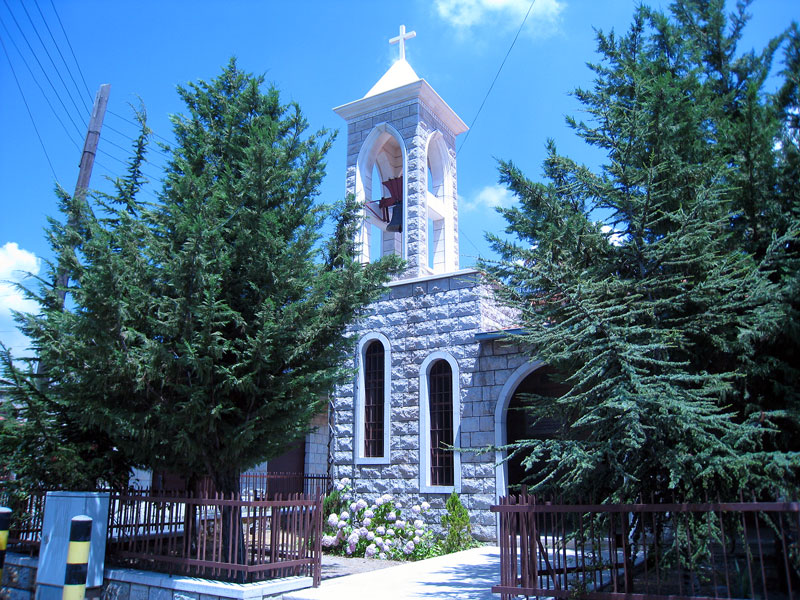
The Arab Evangelical Church in Mrouj, where the Armenian Evangelical Worship services are held during the Summer
Raffi - What is the need that you saw in Mrouj, for which you worked to have church services there?
Vartoug & Ani - Basically, it started in response to a personal need. As you know the village is about 45 minutes from Beirut, and to go down to attend a worship service at our Church meant giving at least three hours of Sunday mornings. So, to go down on a Sunday, proved to be time consuming and on many days simply impossible, because we had to leave behind guests, and most of our guests would like to visit us during the week ends. Of course there is an Evangelical church in Mrouj in itself and some others in nearby villages, but they are not in Armenian.
Raffi - What steps did you take to start implementing this vision?
Vartoug & Ani - The first step was to share the concern among ourselves, we mean those who practically live in Mrouj during the summer months. Then Ani, who is a member of the Church board, raised the issue at one of their meetings. The idea of having worship service was soon adopted by the church board. Then she contacted Mr. Edward Kharrat, an elder in the Mrouj evangelical church and asked for permission to use the church premises for Armenian worship after their service on Sunday morning. After getting the permission, brochures and posters were prepared and the children in our families helped distribute them to the shops and Armenian families to announce the start of the services.
Raffi - Who participates in the Sunday services and how many attend from the Armenian families in Mrouj?
Vartoug & Ani - There are around ten families, members of which attend regularly. Then are some Armenian families from the neighboring villages who attend more or less regularly. An average number of 30 persons attend the services; some days it is far above that number, on others it is far less!
Raffi - What are the difficulties that you faced?
Vartoug & Ani - A major difficulty was music. The local church did not use the piano they had. So, we had to bring an expert to tune it. Then came the difficulty of finding a piano player each Sunday. Another difficulty was task distribution. There were times when one person carried the whole burden – except that of preaching.
Raffi - How do you see the response of the Armenian Evangelical churches and the Arab Evangelical church to this initiative?
Vartoug & Ani - The local church was more than happy to lend the church hall for Armenian Evangelical worship service. As for the response of the Armenian Evangelical Churches – no direct comments reached us, but all those- and by those we mean pastors and lay people alike- who were approached and asked to lead a service, or preach , or play the piano from different Armenian Evangelical churches, were positive and eager to respond. We are thankful for them all.
Raffi - What are the long term plans?
Vartoug & Ani - The big vision. Well, how big do you want us to make our vision? We would like to see the Armenian Evangelical church, that is half-built in Mrouj, to be completed, so that full church activities could be carried on there in summers; like Sunday school, ladies’ meetings, junior & youth meetings, Bible studies and prayer meetings. A closer vision would be to see more people who live in Mrouj in summers attend these services.

The Armenian Evangelical Church in Mrouj, which was left half-built after the war started in the 70s.
Haigazian University Baccalaureate Service for the Class of 2011
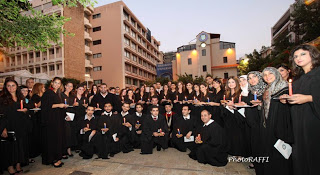 “Take time to listen to the inner, gentle voice within yourself … and perhaps then you will hear that voice telling you ‘Well done, good and faithful servant’.” These words sum up the message offered by Rev. Robert Sarkissian, vice-chair of the Haigazian University Board of Trustees, to the graduating class of 2011 at the Baccalaureate Service held on Sunday, June 26th 2011, in the First Armenian Evangelical Church in Beirut.
The service, which many graduates attended with their families, commenced with a prelude by students Talar Mandoyan and Sarine Kradjian, on the flute and the piano respectively. A processional hymn marked the entrance of the graduating class of 2011 as they made their way through the church.
Christophe Demirdjian, a graduating student of Haigazian University, gave the call to worship.
This was followed by “Amazing Grace,” a classic hymn of praise beautifully sung by student Ruba Habiby and accompanied by Michael Kattan on the guitar. Another student, Vartoug Balekjian, offered the prayer of invocation.
“Today is the preparation of the heart for what the hands will receive next Friday,” announced Rev. Dr. Paul Haidostian, president of Haigazian University, in his welcoming address. He emphasized the importance of gratitude and thanksgiving to God and to other people. “If this degree you value will not function in terms of giving to others, it will lose its meaning,” Haidostian said. He then added that “God blesses the ones who have grateful hearts.”
Haidostian concluded with his wishes and prayers for the peace of God to be in the hearts of all those present there today.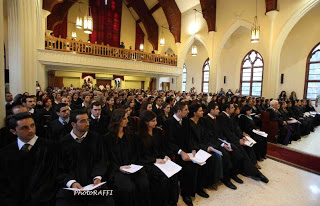 Following the president’s word, graduating student Dima Matta beautifully led the reading of Psalm 40, which included responses read by the audience. The next two graduates to contribute to this service were Nabil Habiby and Denise Rizk, who each shared their reflections as students of Haigazian University and in particular their appreciation for Spiritual Life at the university.
Michael Kattan and Ruba Habiby then sang the song of exhortation, a poignant hymn entitled “God Will Make a Way.” Graduates Hovig Tchilinguirian and Chukri Charbetji then each read a passage from the Bible.
In his address to the graduating students, Rev. Robert Sarkissian urged them to “listen” in all the aspects of their lives, whether it be in their career or in their life as responsible members of society. “From everywhere resounds the call to listen,” said Rev. Sarkissian, adding that his message was specifically applicable to these graduates as the leaders of tomorrow. He urged them to listen to the needs of the poor and the cries of cleared forests and polluted seas, and finally to listen to the voice of God within, with a heart “overflowing with thankfulness.”
Rev. Sarkissian concluded his message with words that reverberated throughout the church and the hearts of everyone there: “Hallelujah, hallelujah and forever hallelujah.”
 This was followed by a prayer of dedication offered by Rev. W. Gregory Lee-Parker, campus minister of Haigazian University, after which students Wissam Baassiri and Sbidag Sarhadian read the pledge of the graduates: “We, the class of 2011 of Haigazian University, in receiving this light, pledge to hold high the light of truth, to defend the light of freedom, and to spread the light of service to our communities, our country and our world. With truth, freedom and service illuminating our hearts, we will challenge each other, and our world, to uphold the worth of each human being, and we will strive for the betterment of society, knowing that this is pleasing to God.”
 To conclude the service, the President of the Union of the Armenian Evangelical Churches in the Near East, Rev. Megrdich Karagoezian, pronounced the benediction, whereupon the class of 2011 marched out of the church with the recessional, each carrying the light of truth, freedom & service to the world. The service was followed by an informal reception in the Mugar Garden.
Pastors and Elders Who Participated in the Sunday Services, During 2010 Summer, Held in Mrouj
Organized by the Armenian Evangelical Emmanuel Church and for the second year, Sunday worship services were held in the Arab Evangelical Presbyterian Church of Mrouj, at 10:30am, starting from Sunday, 11 July 2010 till Sunday, 26 September 2010.
The following pastors and elders preached:
- Mr. George Khacherian (elder in the Armenian Evangelical Marash Church)
- Rev. Hagop Sarkissian (then the pastor of the First Armenian Evangelical Church)
- Rev. Soghomon Kilaghbian (pastor of the Armenian Evangelical Church of Ashrafieh)
- Rev. Dr. Paul Haidostian (president of Haigazian University)
- Mr. Serop Seropian
- Dr. Arda Ekmekji (dean of Arts and Sciences Department of Haigazian University)
- Mrs. Vera Svajian (pastor's wife of the Armenian Evangelical Emmanuel Church)
- Mrs. Maral Deyirmenjian (principal of the Armenian Evangelical Central High School, Ashrefieh)
- Rev. Megerdich Karagoezian (president of the Union of the Armenian Evangelical Churches in the Near East)
- Badveli Sebouh Terzian (Executive Director of the UAECNE)
- Rev. Hovhannes Svajian (pastor of the Armenian Evangelical Emmanuel Church)
The following elders led the worship:
- Ms. Ani Baboghlanian (elder in the Armenian Evangelical Emmanuel Church)
- Mr. Samuel Svajian (elder in the Armenian Evangelical Emmanuel Church)
The 90th anniversary of the Howard Karagheusian Commemorative Corporation in Armenia
The board members, chairmen and friends of the Corporation in New York, Lebanon, Syria and Armenia, met in Armenia to participate in the 90th anniversary celebrations.
Howard Karagheusian Commemorative Corporation was established in 1921 in New York by Mihran and Zabel Karagheusian, brother and sister of Arshak Karagheusian, for the purpose of caring, healing and educating the orphans.


Howard Karagheusian Commemorative Corporation was established in 1921 in New York by Mihran and Zabel Karagheusian, brother and sister of Arshak Karagheusian, for the purpose of caring, healing and educating the orphans.
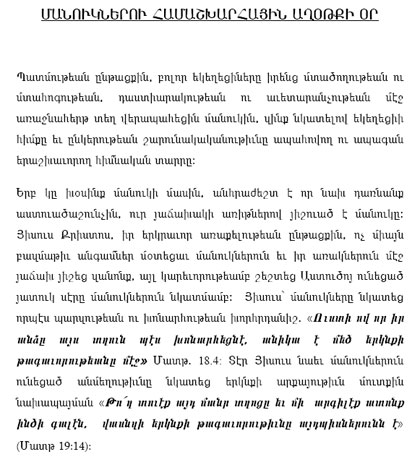
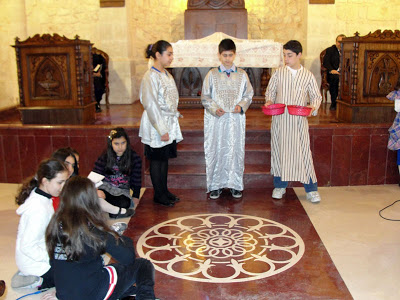
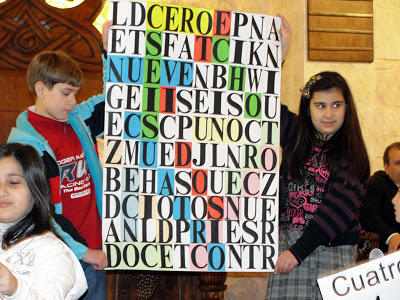
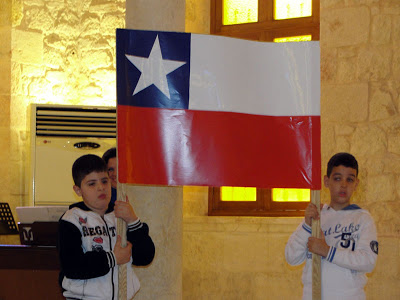
Մանուկներու Համաշխարհային Աղօթքի Օր
Cyprus: Congratulatory Visit to Mr. Vartkes Mahdessian

June 19, 2011, Nicosia: A delegation from the Armenian Evangelical Church in Cyprus visited Mr. Vartkes Mahdessian, the newly-elected Armenian member of the Cyprus parliament. Mr. Mahdessian was first elected in 2006, representing the Armenian community. The Armenians are considered a minority in the Republic of Cyprus and are officially recognized and registered as a Religious Community (gronagan hamaynk) with rights and privileges. The parliamentary elections took place on May 22, 2011, where Mr. Vartkes Mahdessian was re-elected with a majority vote for a new 5-year-term. The visit took place on Saturday, June 18, 2011, to congratulate Mr. Mahdessian.
The delegation representing the Armenian Evangelical Church included Mrs. Nevart Kassouni- Panayiotides, Mr. Hagop Chopourian, Mr. and Mrs. Noris and Seta Gulesserian, Mr. and Dr. Hrayr and Arda Jebejian and Mr. and Mrs. Mihran Jizmejian (Executive Director, AMAA, Canada).
Mr. Hrayr Jebejian thanked Mr. Mahdessian for his dedicated service to the Armenian community and emphasized the importance of working together as various organizations and groups within the Armenian community in Cyprus. He also assured Mr. Mahdessian of the readiness of the Armenian Evangelical Church to continue its contribution to the welfare of the community.
Mr. Mahdessian thanked the delegation for their visit and re-assured them of his willingness to work closely with the different units in the Armenian community. The visit was also a good opportunity to share ideas and concerns about the various issues related to the community life in Cyprus. Mr. Hrayr Jebejian, and on behalf of the Armenian Evangelical Church, presented Mr. Mahdessian a plaque - The Lord’s Prayer - (Hayr Mer) as an appreciation and acknowledgement of his past and future services as the Representative of the Armenian community in the Cyprus parliament.